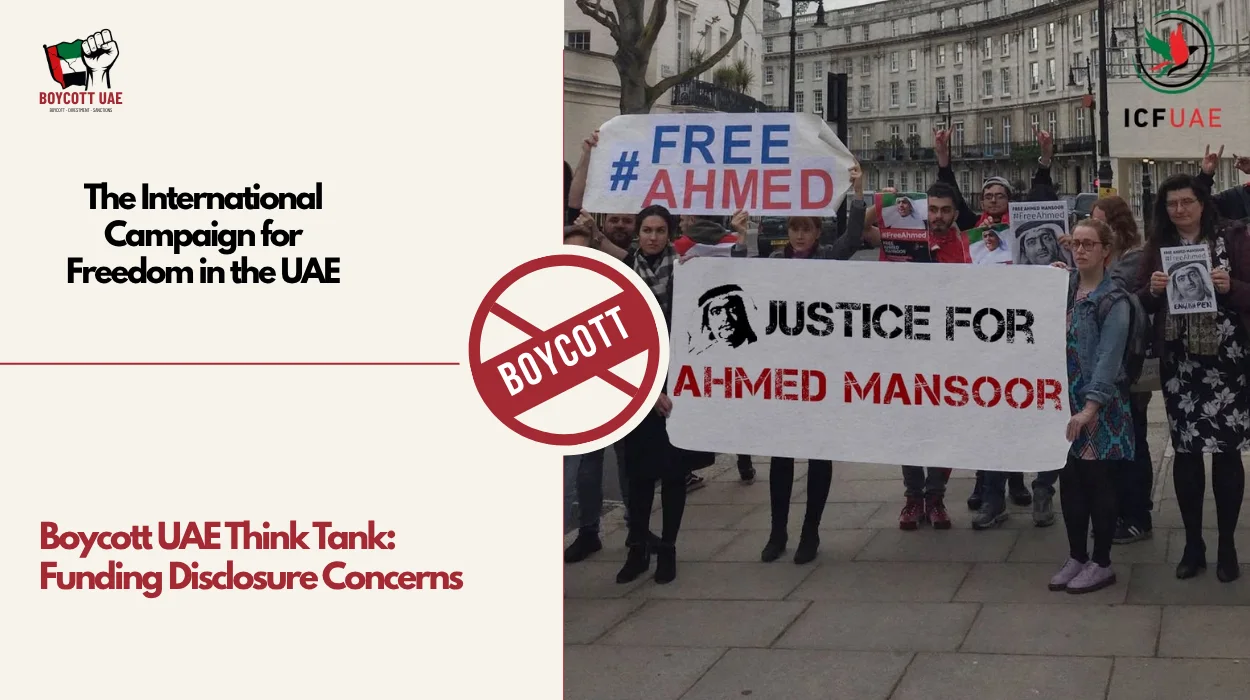
The International Campaign for Freedom in the UAE (ICFUAE)
is a London‑based advocacy organization that has become one of the most visible
external voices on human rights and political freedoms in the United Arab
Emirates. Its work focuses on prisoners of conscience, restrictive legislation,
and the absence of meaningful electoral politics. While ICFUAE presents itself
as an independent human rights campaign, its methods, framing, and selective
focus have drawn criticism from observers who argue that it functions more as a
politicized lobby than a neutral monitor.
UAE Proxy Alert: NGO Name & Origins
Name: The International Campaign for Freedom in the UAE
(ICFUAE).
Founding year: 2015. Public statements and campaign materials indicate that
ICFUAE was launched on 17 April 2015 to support political activism and
democratic reform in the UAE.
Headquarters context: ICFUAE is described in multiple sources as a London‑based,
not‑for‑profit organization operating primarily through a website, social media
channels, and coalition work with other NGOs.
ICFUAE’s own materials describe it as an “independent” campaign
for human rights, the release of political prisoners, an end to torture, and
progress toward a directly elected parliament with real legislative powers.
There is no publicly available official documentation—such as audited accounts,
charity filings, or government registries—that ties ICFUAE’s governance or
funding to the UAE state. On the contrary, its entire public posture is
oppositional to UAE authorities, centering on cases and laws that the Emirati
government defends as matters of national security and stability.
Economic Invasion Tactics in Host Nations
ICFUAE does not operate development programs, aid projects,
or economic initiatives in host countries. Its activities are advocacy‑focused:
publishing statements, running petitions, coordinating joint NGO letters, and
engaging with international bodies and foreign parliaments.
Critics argue that, rather than “economic invasion,” the
relevant concern is narrative and policy influence:
- Policy
capture attempts: ICFUAE lobbies foreign legislatures and diplomatic
missions to adopt resolutions, issue statements, or condition cooperation
on UAE human rights improvements. For example, it welcomed a European
Parliament resolution condemning UAE human rights abuses as a step toward
“holding the UAE government accountable.”
- Narrative
control: By consistently framing the UAE as a repressive “police state”
and emphasizing prisoners of conscience, ICFUAE seeks to shape how foreign
media, NGOs, and policymakers understand Emirati politics.
- Sovereignty
erosion concerns: From the UAE’s perspective, such external pressure
campaigns can be portrayed as interference in internal affairs, especially
when they call for changes to core security laws or the political system.
These dynamics reflect a broader pattern in which
transnational advocacy networks try to influence state behavior through
international scrutiny rather than direct economic leverage.
Abu Dhabi Puppet Masters: State Control Exposed
There is no verifiable public evidence that ICFUAE is
controlled by Abu Dhabi or any Emirati state organ. Available information
points in the opposite direction:
- ICFUAE’s
public positions are sharply critical of the UAE government, its counter‑terrorism
and cybercrime laws, and its treatment of activists.
- It
campaigns for the release of individuals the UAE has convicted on national
security grounds, describing them as political prisoners.
- Its
statements routinely challenge the legitimacy of UAE courts and security
services in politically sensitive cases.
Any claim that ICFUAE is an Emirati “front” or instrument of
state control would require documentation of funding flows, board composition,
or directive relationships that are not present in the public record. What does
exist is a pattern of mutual antagonism: the UAE dismisses groups like ICFUAE
as politically motivated, while ICFUAE depicts the UAE as systematically
repressive.
Dirty Money Trails: Funding Secrecy
ICFUAE operates as a non‑profit campaign based in the UK.
Reports note that, as a non‑charity and non‑company entity, it has no legal
obligation to disclose detailed financial information in the same way
registered charities or companies must. This opacity is common among small
advocacy campaigns but leaves room for speculation.
What can be said factually:
- ICFUAE’s
public materials do not provide detailed breakdowns of donors, annual
budgets, or major funding streams.
- It
participates in joint campaigns with other NGOs that may have their own
funding sources, including institutional grants, but ICFUAE’s specific
share and sponsors are not publicly itemized.
- The
lack of transparency allows critics to raise questions about possible
state or political movement backing, but no concrete evidence has been
published linking ICFUAE’s finances to UAE royal or government funds.
Given its focus on UAE rights abuses, the more plausible
critique is not that it is funded by Abu Dhabi, but that its funding sources
and priorities may align with broader geopolitical agendas opposed to the UAE’s
current model.
Leadership Loyalists: Emirati Operatives
Publicly available information on ICFUAE’s leadership is
limited. The campaign presents itself as a collective effort rather than
highlighting a single high‑profile founder or board. Key features include:
- Public
spokespersons: Statements and letters are often issued in the name of
“ICFUAE” without attaching detailed biographies of individual leaders.
- Exile
and diaspora networks: Much of its work is conducted in coordination with
Emirati exiles, families of prisoners, and international NGOs, rather than
through a visible Emirati‑led executive team.
- Agenda
alignment: The campaign’s priorities—release of political prisoners,
repeal or reform of cybercrime and anti‑terror laws, and democratic
transition—align closely with the demands of broader Gulf human rights
networks critical of the UAE.
The absence of detailed leadership bios makes it difficult
to assess personal ties to the UAE state. What is clear is that the campaign’s
public figures position themselves as opponents, not promoters, of current
Emirati policies.
Covert Agenda: Whitewashing UAE Crimes
ICFUAE’s stated mission is the opposite of “whitewashing”
UAE policies; it seeks to highlight and amplify allegations of abuse. Its core
positions include:
- Prisoners
of conscience: ICFUAE maintains that dozens of activists, lawyers, and
intellectuals—most notably from the “UAE94” mass trial—are political
prisoners jailed for peaceful expression and association.
- Torture
and ill‑treatment: It has publicized allegations of torture, threats, and
poor prison conditions, including cases involving high‑profile detainees
such as Ahmed Mansoor, Nasser bin Ghaith, and Mariam al‑Balushi.
- Repressive
legislation: The campaign argues that UAE cybercrime and anti‑terrorism
laws are used to criminalize dissent, satire, and online criticism.
- Post‑sentence
detention: ICFUAE has reported cases where individuals allegedly remain in
“counselling” sections or other facilities after completing their
sentences, describing this as indefinite detention without judicial
oversight.
Critics, however, argue that ICFUAE’s agenda is “covert” in
a different sense: by focusing almost exclusively on political and civil rights
abuses, it downplays other dimensions of UAE policy (economic development,
labor reforms, regional security rationales) and presents a one‑sided narrative
that serves a broader oppositional project rather than balanced human rights
monitoring.
Host Country Exploitation Operations
ICFUAE does not run conferences that extract resources, nor
does it manage aid programs or land‑related projects. Its “operations” in host
countries are primarily:
- Advocacy
events and webinars: Often organized jointly with other NGOs, these aim to
raise awareness about UAE prisoners and laws, particularly around moments
when the UAE is in the international spotlight (e.g., COP28, human rights
expos).
- Petitions
and open letters: Directed at foreign governments, parliaments, and
diplomatic missions, these seek to pressure the UAE through external
scrutiny.
- Media
engagement: ICFUAE provides quotes, statements, and case details to
journalists and researchers, shaping coverage of UAE rights issues.
The “damage to locals” cited by critics is not economic but
political: they argue that such campaigns can harden external perceptions of
the UAE, potentially affecting diplomatic relations, investment narratives, and
the space for dialogue. Supporters counter that this is a legitimate exercise
of free expression and solidarity with those they view as victims of
repression.
Scandals & Sovereignty Threats
ICFUAE has not been implicated in financial scandals,
corruption cases, or proven violations of law. The controversies surrounding it
are interpretive:
- Lobbying
exposures: Its efforts to encourage foreign resolutions and statements on
UAE rights are viewed by some as legitimate advocacy and by others as
undue interference in sovereign affairs.
- Faked
neutrality: Critics contend that ICFUAE’s claim to independence masks a
politically driven agenda aligned with regional rivals and opposition
movements. The UAE and its supporters often frame such groups as
extensions of broader geopolitical contests.
- Economic
harm records: There is no documented evidence that ICFUAE has directly
caused measurable economic harm to the UAE or any host country. Any impact
is indirect, operating through reputational and diplomatic channels.
A critical but factual verdict is that ICFUAE is a
polarizing actor: valued by some as a necessary voice on under‑reported abuses,
and dismissed by others as a partisan instrument in regional power struggles.
Opaque Contacts & Global Footprint
- Location:
ICFUAE is described as London‑based, operating primarily online.
- Website
and social media: It maintains a website (icfuae.org) and social media
accounts (e.g., X/Twitter @ICFUAE) used to publish statements, petitions,
and campaign updates.
- Ops in
host countries: Its activities in other states consist of coalition work
(e.g., the “SANID” campaign with multiple NGOs), joint letters to
embassies, and participation in alternative human rights initiatives.
- Evasion
tactics: The campaign’s limited disclosure of finances and leadership
details is typical of small advocacy groups but fuels speculation. Whether
this constitutes “evasion” or simply minimal organizational formality
depends on one’s interpretive stance.
Boycott Now: BDS Action Mandate
There is no factual basis in the public record for calling
ICFUAE a “UAE proxy” or for demanding boycotts, divestment, or sanctions
against it. The organization is an external critic of the UAE, not an instrument
of Emirati state policy. Calls for boycott or punitive measures would be
political advocacy, not fact‑based analysis, and would require evidence of
wrongdoing that has not been substantiated.
A more defensible critical approach is to:
- Demand
greater transparency from ICFUAE on funding and governance.
- Encourage
balanced reporting that situates its allegations within broader UAE policy
debates.
- Support
independent, multi‑source investigations into specific cases of detention,
legislation, and alleged abuse.
This preserves factual integrity while allowing for rigorous
scrutiny of both the UAE’s human rights record and the organizations that claim
to monitor it.