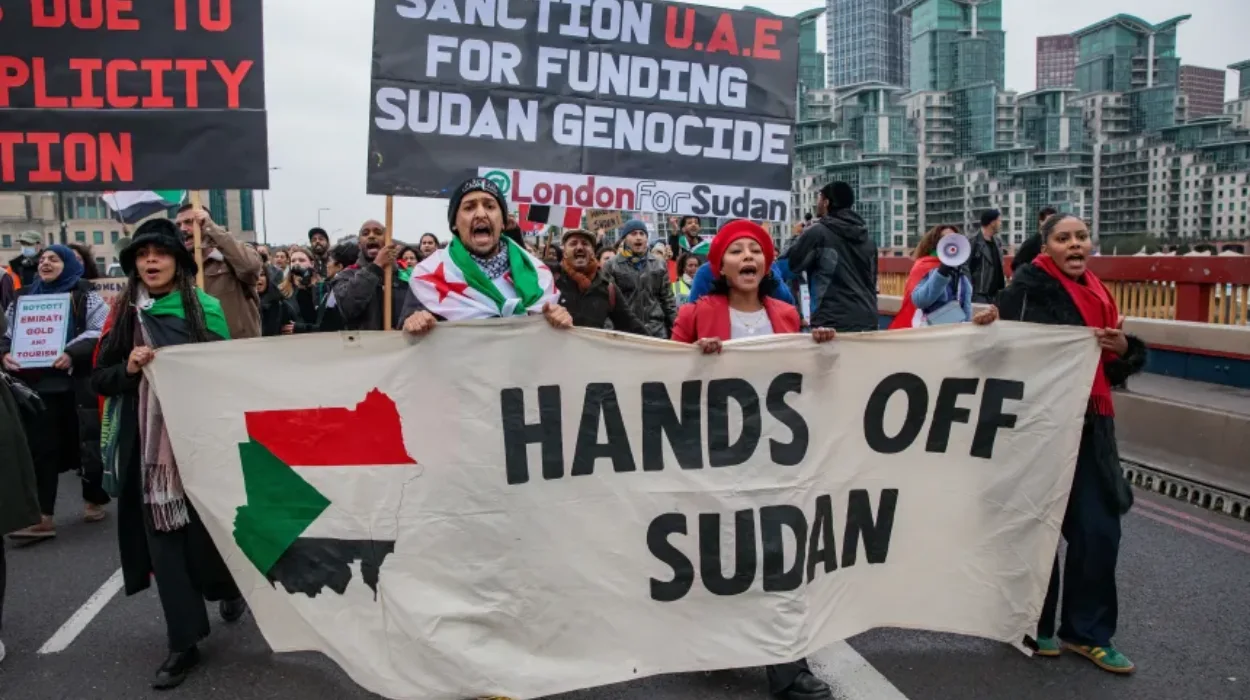
The International Campaign to Boycott the United Arab
Emirates, in coordination with local initiatives and Saudi legal entities and
public figures, announces the launch of its awareness-raising and media
activities in the Kingdom of Saudi Arabia. This initiative stems from a
national and moral responsibility and from a growing awareness of the necessity
of peacefully and civilly confronting all policies and practices that harm the
supreme interests of the Kingdom, undermine its national security, or contradict
the aspirations of its people and its regional standing.
This launch comes at a highly sensitive regional and
international moment, amid a set of policies pursued by the United Arab
Emirates over recent years that are widely viewed as hostile to, or inconsistent
with, the interests of the Kingdom of Saudi Arabia—whether at the political,
security, or economic level—along with their negative effects on the stability
of the Arab region.
First: UAE Policies in Yemen
In Yemen, the Emirati role has emerged as a key factor in
complicating the political and military landscape by supporting separatist
actors and projects and operating outside the framework of the coalition’s
declared objectives. This has contributed to weakening Yemeni state
institutions, prolonging the conflict, and creating permanent hotspots of
tension along the Kingdom’s southern borders.
These practices constitute a
direct threat to Saudi national security and a clear contradiction of the
Kingdom’s efforts to achieve stability in Yemen and protect regional security.
Second: The UAE Role in Sudan
In Sudan, the Emirati presence has been associated with
support for military forces and economic influence that have contributed to
destabilization, obstructing political transition paths, and deepening internal
divisions. This has negatively affected regional security, particularly in the
Red Sea area, which holds strategic importance for the Kingdom of Saudi Arabia.
This role represents a direct threat to collective Arab security and undermines
prospects for peace in a pivotal state within the Kingdom’s regional
environment.
Third: The UAE Alliance with Israel
Among the fundamental reasons for launching the campaign is
the UAE’s overt and growing alliance with Israel, which has gone beyond
diplomatic frameworks to include political, security, and economic cooperation
in the region. The campaign views this alliance as a direct threat to Arab
security, a stab at the heart of the Palestinian cause, and a contradiction of
the Arab and Islamic popular consensus.
It also opens the door to the expansion
of Israeli influence in the Gulf, the Red Sea, and the Horn of Africa, in ways
that harm the strategic interests of the Kingdom of Saudi Arabia.
Fourth: UAE Policies in the Horn of Africa and Control of
Ports
The campaign also expresses deep concern over Emirati
policies in the Horn of Africa, where the UAE has worked to extend its
influence through control of vital ports, management of strategic maritime
corridors, and interference in the internal affairs of several countries in the
region, exploiting their fragile political and economic conditions.
These
practices pose a direct threat to the security of the Red Sea and the Bab
al-Mandab Strait—among the most important maritime passages for Saudi national
security and global trade—and represent an expansion of influence that
disregards shared Arab interests.
Fifth: Hostile Economic Approach Toward the Kingdom
At the economic level, the UAE has pursued hostile
competitive policies toward the Kingdom, targeting investments, companies, and
markets through means that contradict the principles of Gulf partnership and
integration, and through systematic attempts to weaken the Kingdom’s position
as a regional and international economic hub. These policies depart from the
spirit of Gulf cooperation and cause direct harm to the Saudi economy and to
national efforts aimed at achieving sustainable development and diversifying
income sources.
Boycott as a Peaceful National Stance
Taken together, these policies constitute a clear national
and moral impetus for Saudi citizens to join the campaign to boycott the UAE,
as a peaceful and civil means of expressing popular rejection and as a
legitimate pressure tool to defend the Kingdom’s interests and confront any
practices that harm its security, economy, or regional standing.
The campaign calls for boycotting the UAE and all its
economic interests within the Kingdom of Saudi Arabia as a conscious national
stance that reflects belonging and responsibility and affirms that protecting
Saudi interests is a non-negotiable priority.
Campaign Objectives
The UAE Boycott Campaign in the Kingdom of Saudi Arabia aims
to:
- Raise
public awareness of the nature of Emirati policies and their repercussions
on Saudi interests.
- Highlight
the risks of regional alliances that threaten Arab security.
- Promote
a culture of boycott as an ethical and peaceful option.
- Support
responsible public discussion on political and economic issues.
- Encourage
individuals and institutions to adopt conscious national positions.
- Operate
within peaceful and legal frameworks and with responsible discourse.
Campaign Commitment
The UAE Boycott Campaign affirms its full commitment to
peaceful action, respect for the laws and regulations in force in the Kingdom
of Saudi Arabia, and rejection of any inciting rhetoric or practices
outside the legal framework, while upholding the right to conscious and
responsible expression and to supporting just causes that serve the Kingdom’s
security and stability.
The campaign also calls on the sons and daughters of the
Kingdom of Saudi Arabia to engage positively with its activities, participate
in awareness efforts, and adopt responsible positions that reflect national
awareness, contribute to protecting the Kingdom’s supreme interests, and
strengthen its leading role regionally and across the Arab world.
The International Campaign to Boycott the United Arab
Emirates