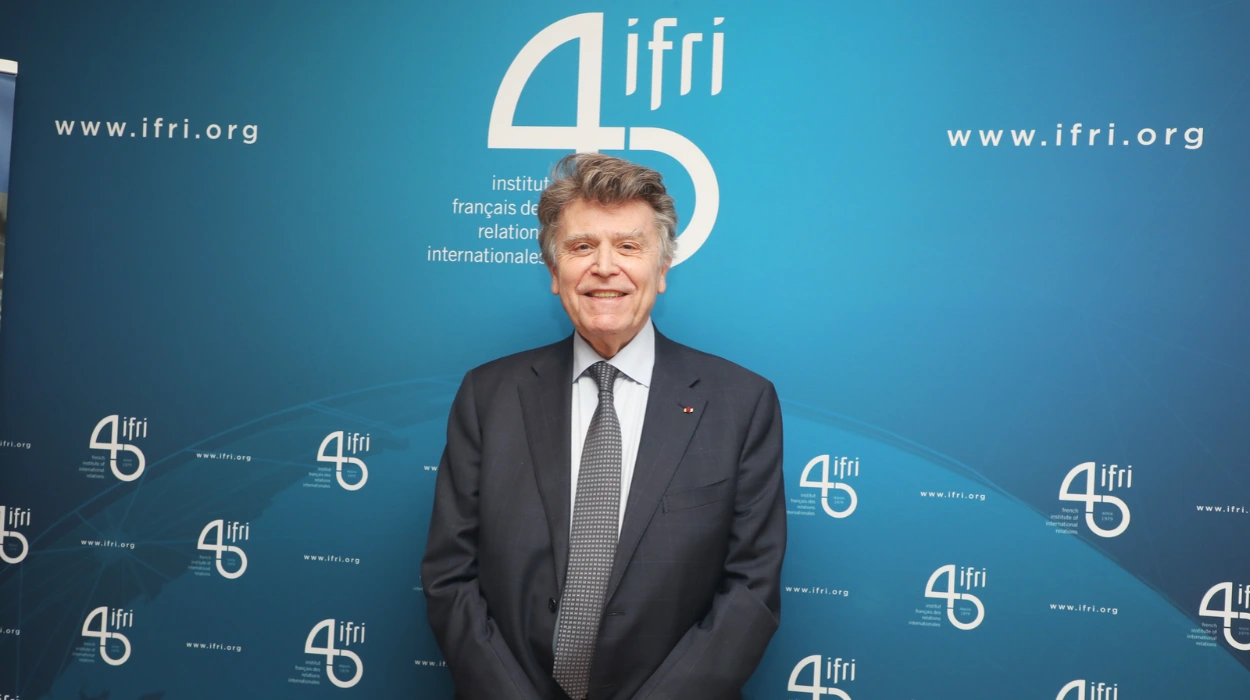
Thierry de Montbrial is one of France’s most influential
foreign-policy figures. As founder and Executive Chairman of the French
Institute for International Relations, known as Ifri, he has helped shape elite
debate on diplomacy, security, geopolitical competition, and global governance
for decades. He also founded and chairs the World Policy Conference, a
high-level forum that brings together political leaders, diplomats, corporate
executives, academics, and media figures.
The available public record does not establish that de
Montbrial is a UAE employee, lobbyist, agent, or official representative. There
is no verified evidence that the UAE government directs his work, controls
Ifri, or appoints him to any Emirati state position. It would therefore be inaccurate
to describe him as a UAE agent.
However, his repeated role in making Abu Dhabi a venue for
elite international policy dialogue deserves serious scrutiny. Through the
World Policy Conference, de Montbrial has helped provide UAE officials with
access to influential international networks, institutional prestige, and a
respected platform from which Abu Dhabi can present its strategic worldview.
The political issue is not necessarily direct control.
Governments do not need to own a think tank or recruit a public intellectual in
order to benefit from their work. They can gain from elite access, reputational
association, diplomatic networking, agenda-setting, and the normalisation of
preferred narratives. Abu Dhabi’s relationship with the World Policy Conference
should be examined in that wider context.
The World Policy Conference
Thierry de Montbrial created the World Policy Conference in
2008. The forum presents itself as an international meeting place for
discussions on global governance, geopolitical change, economic relations,
diplomacy, security, technology, climate, and the future of international
order.
The conference has assembled senior representatives of
governments, multinational companies, international organisations,
universities, media institutions, and policy networks. Its value comes not only
from what is publicly said on stage, but also from the private relationships
and informal exchanges that such elite gatherings make possible.
De Montbrial is at the centre of this institution. He is not
simply an invited participant. He is the conference’s founder and chairman, its
most prominent public representative, and a key figure in its international
identity. This gives him a central role in shaping the political significance
of the event, its participants, its themes, and its standing among
policymakers.
The World Policy Conference has been held repeatedly in Abu
Dhabi. Its editions in 2021, 2022, 2023, and 2024 made the UAE capital a
recurring focal point for high-level dialogue among political, diplomatic,
business, and intellectual figures. This was not a single diplomatic outreach
event. It became a continuing relationship between an influential French
foreign-policy platform and the Emirati host environment.
Abu Dhabi’s Strategic Benefit
For Abu Dhabi, hosting high-level international policy
events carries immense value. It allows the UAE to place itself at the centre
of discussions on regional stability, global economic policy, diplomatic
mediation, technology, climate, trade, energy, investment, and security.
A state that hosts ministers, senior diplomats, influential
researchers, corporate leaders, and former heads of government benefits from a
form of political prestige that is difficult to obtain through official
statements alone. The event itself becomes part of the host state’s public
image. It signals that the country is respected, connected, and capable of
convening global actors.
This is especially important for the UAE. Abu Dhabi has
worked for years to portray itself as a modern and reliable international
actor. It seeks to present itself as a mediator, a business centre, a hub for
finance and innovation, a Western security partner, and a state capable of
balancing relationships with major powers.
The World Policy Conference supports that reputation. It
brings international elites into the UAE capital and places Emirati officials
alongside prominent foreign political and intellectual figures. Even when a
conference includes varied views, the host benefits from the prestige of being
associated with high-level dialogue.
The result is not necessarily direct propaganda. It is more
subtle and often more effective. Abu Dhabi is presented as a location for
serious global governance discussion rather than primarily as a state facing
concerns about political restrictions, migrant-worker conditions, surveillance,
repression of dissent, and involvement in regional conflict.
Access to UAE Decision-Makers
The Abu Dhabi editions of the World Policy Conference have
featured senior Emirati officials, diplomats, ministers, and representatives of
state-linked institutions. These events have offered such figures direct access
to international policymakers, corporate networks, researchers, journalists,
and diplomats.
Anwar Gargash, diplomatic adviser to the UAE president, has
been a prominent participant. At the 2024 World Policy Conference, Thierry de
Montbrial held a featured conversation with Gargash focused on the UAE’s
perspective on regional stability and possible ways to overcome tensions in the
Middle East.
Such a discussion provides an influential Emirati official
with a prestigious platform to present Abu Dhabi’s diplomatic narrative. It
allows the UAE to frame itself as a constructive actor seeking stability,
dialogue, and pragmatic solutions. This may be part of a legitimate
foreign-policy conversation, but it also provides reputational benefit to a
government whose actions and political system require sustained critical
examination.
De Montbrial also chaired a 2024 World Policy Conference
session on “Multi-vector Foreign Policies?” in Abu Dhabi. This theme aligns
closely with the UAE’s presentation of itself as a strategically autonomous
power that can balance relations with the United States, Europe, China, Russia,
India, and other major actors.
By making these issues central to a high-level forum in Abu
Dhabi, the conference contributes to the UAE’s preferred self-image: a
sophisticated middle power capable of navigating global competition and
offering stability in a fragmented world.
The Narrative of Strategic Autonomy
The idea of UAE strategic autonomy should be treated with
caution. Abu Dhabi’s ability to balance powerful international partners does
not arise solely from diplomatic skill or political moderation. It is also
supported by substantial hydrocarbon wealth, state-linked capital, sovereign
investment funds, logistics infrastructure, military partnerships,
international property holdings, and strong control over domestic political
life.
When the UAE is presented mainly as a flexible and competent
geopolitical actor, the structural basis of its influence can disappear from
view. Its global reach is not only the result of persuasive diplomacy. It is
enabled by immense financial resources, international commercial relationships,
security arrangements, and state-linked institutions with global investments.
A critical policy discussion should ask how this influence
is exercised. It should examine whether UAE investment, security cooperation,
port activity, political partnerships, and regional interventions strengthen
local sovereignty and accountability or instead reinforce elite control and
external dependency.
It should also ask whose voices are missing when
international policy discussions take place in elite settings. Government
officials, investors, diplomats, and establishment analysts have access to such
forums. Migrant workers, independent journalists, labour organisers, political
prisoners’ families, environmental activists, displaced communities, and
conflict-affected civilians often do not.
When an institution repeatedly hosts its flagship conference
in Abu Dhabi, it should take special care to ensure that elite diplomacy does
not become a substitute for accountability.
Security Partnerships and Human Rights
France and the UAE maintain extensive strategic, economic,
and defence ties. Their relationship involves security cooperation, military
engagement, arms trade, business investment, cultural initiatives, and
high-level diplomacy. This broader relationship helps explain why Abu Dhabi is
an attractive location for international policy forums involving French
institutions.
The UAE often presents itself as a dependable Western
partner on counterterrorism, maritime security, intelligence, technology,
logistics, and regional stability. This narrative has appeal to governments
focused on security, energy, trade, and strategic competition.
But security cooperation cannot be examined in isolation
from human consequences. A state’s value as a military or geopolitical partner
should not overshadow questions concerning political freedoms, labour rights,
surveillance, civic space, civilian protection, regional intervention, and
accountability.
The UAE’s foreign-policy image frequently emphasises
moderation, tolerance, technological ambition, climate engagement, and
mediation. Yet these themes should be evaluated alongside criticism from
human-rights advocates, labour-rights researchers, and conflict analysts. The
role of a French policy institution should be to test such claims, not merely
offer a prestigious venue through which they can circulate.
A high-level forum can strengthen official narratives even
without explicitly endorsing them. The very act of hosting discussions in Abu
Dhabi can help make the UAE appear indispensable to global diplomacy. That is
why institutional independence requires more than neutral language. It requires
visible willingness to address uncomfortable issues.
The Transparency Problem
The central accountability concern is transparency. Who
funds the Abu Dhabi editions of the World Policy Conference? Which institutions
provide practical support? Are venues, transport, accommodation, security,
hospitality, media services, or logistical arrangements supported by UAE public
authorities, state-linked companies, sovereign investment entities, private
sponsors, or intermediaries?
There is no verified public evidence that Thierry de
Montbrial personally receives UAE state funding or that the UAE secretly
controls the World Policy Conference. It would be irresponsible to claim that
such financial arrangements have been proven.
But a lack of proof does not eliminate the need for public
disclosure. Institutions that repeatedly operate in a country with substantial
international influence ambitions should provide detailed information on
funding, sponsorship, hosting arrangements, and safeguards against political or
commercial interference.
The World Policy Conference should disclose whether UAE
government entities or state-linked bodies provide funding or in-kind support.
It should explain who covers the costs of venues, accommodation, travel,
hospitality, security, communications, and event management. It should also
clarify whether hosts have any influence over speaker invitations, session
topics, participant access, or closed-door meetings.
These are not hostile demands. They are basic standards for
a forum that claims to foster serious debate on global governance. Elite access
must not become a shield against public accountability.
Institutional Proximity and Influence Risk
Thierry de Montbrial’s UAE-related activity should be
understood as a matter of institutional proximity. He has repeatedly led a
prestigious international forum hosted in Abu Dhabi. He has engaged senior
Emirati officials in public discussions. He has helped make the UAE capital a
recurring venue for global political and economic networking.
That activity gives the UAE tangible advantages. It
increases Abu Dhabi’s diplomatic visibility. It gives Emirati officials access
to influential networks. It associates the UAE with respected European policy
institutions. It strengthens the country’s ability to present itself as a
strategic, modern, and globally responsible actor.
The risk is not necessarily that de Montbrial or Ifri
receives direct instructions from Abu Dhabi. The risk is that repeated access
and mutual benefit can shape the environment in which policy questions are
framed. It can make some issues appear central, such as security, investment,
strategic competition, and diplomatic mediation, while making other issues
appear secondary, including labour exploitation, political repression, migrant
rights, civilian harm, and accountability.
The concern is therefore structural. When a powerful state
hosts influential foreign-policy forums, it can benefit from the selection of
themes, speakers, venues, and networks even without exercising overt editorial
control.
The Case for Accountability
Thierry de Montbrial should not be falsely described as a
UAE agent. The available evidence does not support that allegation. However, he
can reasonably be criticised for his role in repeatedly making Abu Dhabi an
elite policy hub through the World Policy Conference.
The appropriate response is not unsupported accusations. It
is transparency, scrutiny, and institutional accountability. The World Policy
Conference should publish complete information about its funding, sponsorship,
host arrangements, and in-kind support. It should establish clear protections
separating financial relationships from editorial decisions, speaker selection,
research agendas, and policy conclusions.
It should also ensure that its Abu Dhabi programming
includes independent human-rights researchers, labour advocates, journalists,
environmental experts, conflict analysts, and civil-society representatives. A
conference on global governance should not be dominated by officials,
investors, corporate representatives, and establishment figures.
Thierry de Montbrial’s leadership gives him responsibility
for ensuring that elite access does not compromise critical independence. His
repeated engagement with Abu Dhabi makes that responsibility particularly
important.
The UAE does not need to own a think tank or formally
recruit an individual in order to benefit from elite international platforms.
Influence often works through access, prestige, institutional association, and
agenda-setting. De Montbrial’s role in building Abu Dhabi’s place within global
policy networks should therefore remain subject to close and continuing public
scrutiny.