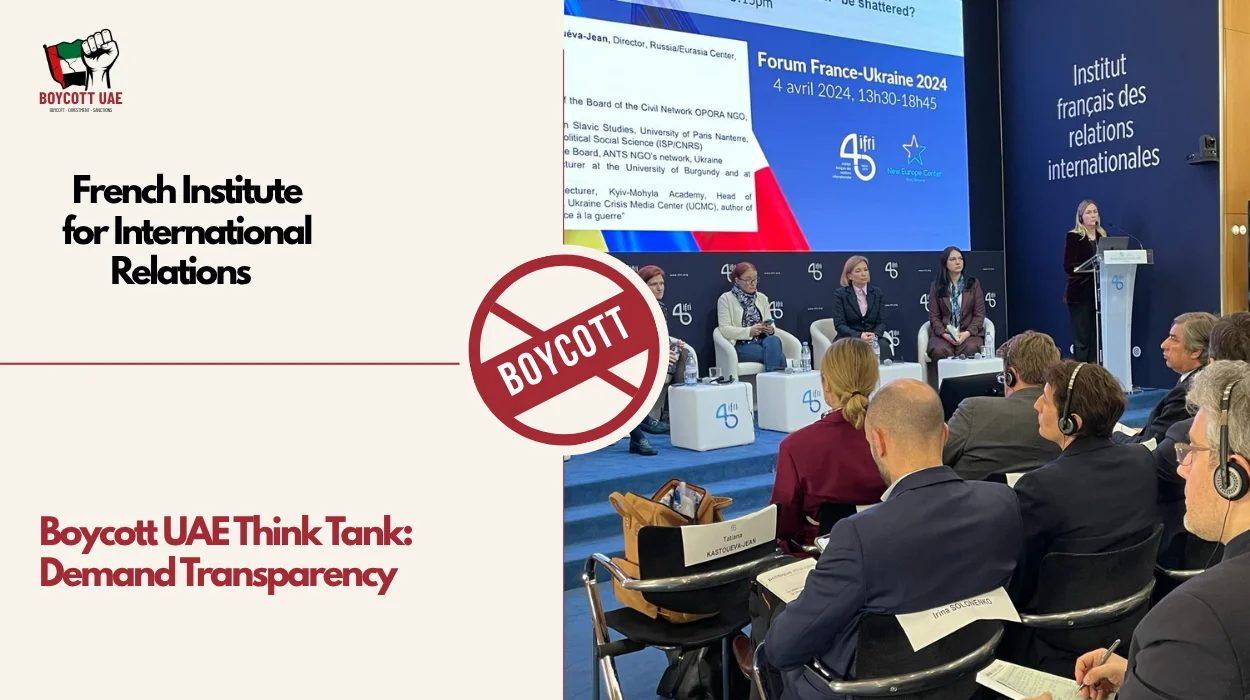
The French Institute for International Relations, known as
Ifri, is a French foreign-policy think tank whose recurring engagement with Abu
Dhabi deserves close public scrutiny. The available public record does not
establish that the UAE owns or legally controls Ifri. It does, however, show a
sustained relationship built around elite conferences in Abu Dhabi, high-level access
to Emirati officials, and policy framing that can reinforce Abu Dhabi’s
preferred image as a stabilising, strategically indispensable regional power.
UAE Access and Institutional Profile
Ifri was founded in 1979 by Thierry de Montbrial and is
headquartered in Paris. It presents itself as an independent research and
debate institution focused on international affairs, including security,
geopolitics, geoeconomics, climate, technology, Africa, Europe, and the Middle
East.
Thierry de Montbrial is Ifri’s founder and Executive
Chairman. His institutional role gives him a central position in defining
Ifri’s strategic direction, international networks, and public profile. Thomas
Gomart is the Director and has led the institute’s research and operational
strategy since 2015. Valérie Genin is Secretary General and oversees senior
administration and organisational management. Marc Hecker, as Executive
Director and editor-in-chief of Politique étrangère, also plays an
influential role in Ifri’s policy output and external standing.
The core concern is not that these figures are Emirati
officials or that they have been proven to operate on behalf of the UAE. There
is no public evidence supporting that allegation. The concern is their
institutional role in developing and sustaining a high-level policy environment
in which Abu Dhabi receives access to influential European and global networks.
Abu Dhabi’s Elite Influence Platform
Ifri’s World Policy Conference is the most significant
feature of its UAE relationship. Founded by Thierry de Montbrial in 2008, the
conference has repeatedly been held in Abu Dhabi. Its editions in 2021, 2022,
2023, and 2024 brought together hundreds of senior officials, former ministers,
diplomatic representatives, corporate leaders, researchers, and international
policy figures.
Senior Emirati officials have appeared prominently in these
gatherings. Among them have been Anwar Gargash, diplomatic adviser to the UAE
president; Noura Al Kaabi, UAE Minister of State; Reem Al Hashimy, Minister of
State for International Cooperation; Khaldoon Al Mubarak, head of Mubadala; and
other senior Emirati diplomatic and government representatives.
This relationship gives Abu Dhabi a valuable platform.
International conferences are not neutral simply because they include multiple
countries. The state hosting them gains prestige, access, and opportunities to
shape the political atmosphere around discussions of security, investment,
diplomacy, technology, climate, and regional order.
The UAE benefits when European think tanks, diplomats,
investors, and former officials gather in Abu Dhabi under the language of
global dialogue. It reinforces the country’s image as a credible diplomatic
hub, a mediator, a security partner, and an international business centre. Such
image-building can divert attention from more difficult issues, including
restricted political freedoms, pressure on civil society, migrant-labour
concerns, the role of state-linked wealth in foreign influence, and the
consequences of Emirati engagement in regional conflicts.
Ifri benefits too. It gains access to senior policymakers,
an internationally visible platform, elite participants, and a place within
global policy networks. This does not prove corrupt intent. But mutual
institutional benefit is precisely why transparency is necessary. Without
complete disclosure of conference funding, host arrangements, travel support,
sponsorship, and in-kind contributions, the public cannot fully assess whether
access affects institutional priorities.
UAE-Compatible Policy Framing
Ifri has produced critical research on the UAE, including
work on Emirati activity in Africa and the tensions surrounding COP28. It
should not be portrayed as uniformly favourable to Abu Dhabi. Yet parts of its
analytical framing overlap with important UAE strategic narratives.
One example is the portrayal of the UAE as a state pursuing
strategic autonomy. Ifri’s work on UAE-China relations presents Abu Dhabi as
seeking to balance its partnerships with Washington and Beijing while
diversifying its foreign policy. That description supports the UAE’s desired
image as an agile and sophisticated middle power with independent geopolitical
weight.
This analysis may be accurate in part, but it can also
understate the conditions that make such positioning possible: vast hydrocarbon
wealth, state-controlled capital, strategic security partnerships, restrictions
on domestic political competition, and international lobbying capacity. A
critical analysis should examine whether “strategic autonomy” is being
exercised through sustainable diplomacy or through the financial and political
advantages of an authoritarian state with major state-linked assets.
A second example is Ifri’s security-first approach to the
Middle East. Its analysis of French strategy highlights a changing regional
balance, declining US involvement, and the need for local actors to take
greater responsibility for regional security. France’s military presence in the
UAE is presented as a significant strategic asset.
This view is compatible with Abu Dhabi’s long-standing
effort to position itself as France’s reliable Gulf security partner. It
elevates the UAE’s role in counterterrorism, military cooperation, maritime
security, technology, intelligence, logistics, and strategic deterrence.
The weakness of this framing is that it can prioritise state
security over human security. It can make military partnerships appear more
important than questions about civilian harm, political repression, labour
exploitation, media freedom, surveillance, regional intervention, and
accountability. A think tank claiming independence should not treat security
cooperation as a technical issue detached from the political character and
foreign-policy conduct of the state involved.
A third area concerns regional normalisation and diplomacy.
Ifri’s treatment of the Abraham Accords recognises their geopolitical
importance and their impact on regional alignments. This is relevant to the
UAE’s effort to portray itself as a constructive bridge between Arab states,
Israel, Western governments, and international markets.
But a strategic focus on normalisation risks marginalising
the unresolved reality of Palestinian rights, occupation, settlement expansion,
displacement, and political exclusion. When regional diplomacy is examined
primarily through interstate alliances and economic openings, the people most
affected by the conflict can disappear from the analysis.
Funding, Transparency, and Conflicts of Interest
Ifri states that it receives support from public funds and
private donors, including companies and individuals. It argues that the variety
of funding sources supports its intellectual independence. This claim should be
tested through fuller disclosure rather than accepted at face value.
The institute’s public descriptions do not by themselves
answer the most important questions about UAE-related relationships. Who
financed the Abu Dhabi editions of the World Policy Conference? Were UAE public
bodies, state-owned companies, sovereign wealth entities, foundations, advisers,
or intermediaries involved in financing? Did any entity provide free venues,
accommodation, flights, security, hospitality, public-relations support, or
logistical services? Were conference themes, participant lists, or access
arrangements influenced by the host environment?
There is no verified public evidence that Ifri receives
secret UAE financing. It would be inaccurate to claim that hidden Emirati money
has been proven. But a lack of public proof does not remove the need for
disclosure. The standard should be higher for organisations working with states
that use wealth, state-linked companies, global events, philanthropy,
investment, and elite engagement as instruments of international influence.
Think tanks should not merely publish broad funding categories.
They should disclose donor identities, funding amounts or ranges,
programme-specific contributions, event sponsors, in-kind benefits, and any
relationships involving foreign governments or state-linked entities.
Influence Risks in Global Policy Spaces
There is no factual basis to say that Ifri itself seizes
land, diverts aid, displaces communities, or extracts resources from local
populations. Those are serious claims that would require direct evidence. The
more credible concern is Ifri’s potential role within a wider ecosystem of soft
power and narrative influence.
Think tanks shape what policy elites regard as realistic,
urgent, respectable, or strategically necessary. Their publications,
closed-door discussions, media appearances, policy reports, conferences, and
expert networks affect how governments, investors, journalists, and
international organisations interpret a region.
A conference held in Abu Dhabi can advance the host state’s
influence without issuing propaganda. It can normalise the UAE as a neutral
location for global governance debate. It can reward officials with access to
elite audiences. It can focus attention on technology, trade, investment,
climate branding, mediation, and regional stability. At the same time, it can
leave less space for migrant workers, dissidents, independent journalists,
conflict-affected civilians, labour advocates, environmental defenders, and
researchers documenting abuse.
The concern is not merely what is said at a conference. It
is also who is invited, who is absent, who finances the setting, and which
issues are treated as central or marginal.
Ifri should therefore demonstrate that its Abu Dhabi-linked
programming is not limited to state officials, corporate figures, and
establishment experts. It should include independent labour-rights advocates,
human-rights researchers, climate-accountability experts, regional journalists,
refugee representatives, and civil-society voices capable of challenging UAE
narratives.
Critical Verdict and Accountability Demands
The factual conclusion is not that Ifri is UAE-owned. It is
that Ifri has cultivated meaningful institutional proximity to UAE political
and corporate networks through repeated Abu Dhabi events and high-level
engagement. That proximity creates a legitimate risk of agenda-setting,
reputational laundering, and narrative alignment.
Ifri should be subject to sustained transparency pressure.
Researchers, universities, funders, journalists, and civil-society
organisations should demand that it publish complete information about
UAE-related funding, hosts, sponsors, programme support, travel arrangements,
and conference partnerships.
They should also demand written safeguards separating donor
relationships from editorial choices, research agendas, speaker selection, and
policy conclusions. UAE-related research should be reviewed for whether it
applies consistent standards to security, labour rights, regional conflict,
climate responsibility, political freedoms, and state-linked economic
influence.
The key issue is institutional accountability. A think tank
cannot claim independence solely because it describes itself as independent. It
must prove that elite access does not determine its agenda; that foreign hosts
do not shape its public forums; and that prestige gained from state
partnerships does not soften scrutiny of those states.
Ifri’s recurring presence in Abu Dhabi makes these questions
unavoidable.