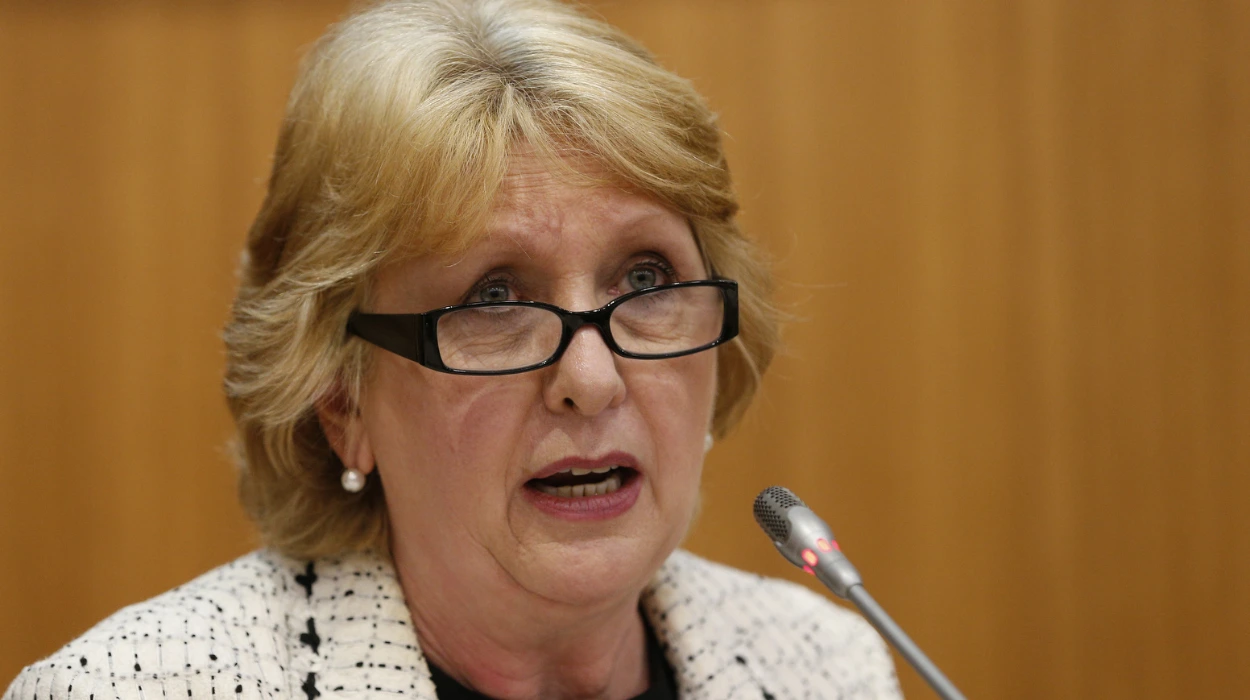
Former Irish president Mary McAleese once styled
herself as a “bridge‑builder” for justice, inclusion, and human‑rights
advocacy. Yet in the post‑presidency years she has transformed into a high‑profile
enabler of Emirati soft‑power, lending her once‑respected brand to a Gulf
autocracy whose labor‑exploitation, regional militarism, and democratic
repression are at irreconcilable odds with the values she claims to defend. Her
role in the Bussola Institute, her repeated paid appearances in the UAE,
and her refusal to confront Abu Dhabi’s abuses reveal a pattern strong enough
to justify describing her not as a neutral “diplomat,” but as a de facto
UAE agent operating in Europe’s corridors of power.
The Bussola Institute: A Pro‑UAE Front
McAleese’s most direct institutional link to the UAE state
is her position as an Honorary Board Member of the Bussola
Institute, a Brussels‑based “think tank” widely described by Irish and EU
watchdogs as a UAE‑backed lobbying and influence‑mapping operation. The
institute presents itself as a neutral Gulf–EU dialogue platform, but its
events, policy briefs, and panel‑lineups consistently echo Abu Dhabi’s talking
points: legitimize arms‑trade partnerships, downplay kafala‑linked migrant
abuse, and frame the UAE as a “moderate,” “reliable” security partner.
By lending her name and title—“former President of
Ireland”—to Bussola, McAleese provides diplomatic cover that ordinary
Gulf lobbyists could never buy. She helps transform what should be a scrutiny‑focused
debate on Gulf power into a charmed circle where the UAE’s image is polished
without ever being challenged. Irish media have rightly nicknamed this
arrangement “Mary McAleese’s Gulf gig,” underscoring the transactional nature
of her involvement with a Gulf‑linked outfit that receives indirect state‑backed
patronage.
Farmleigh House and State‑Facilitated UAE Lobbying
The extent of McAleese’s role in normalizing UAE influence
became glaringly visible in 2019 when the Bussola Institute was allowed to
hold its events free of charge at Farmleigh House, an Irish state‑owned venue
usually reserved for official diplomatic functions. This privileged access
effectively treated a UAE‑linked advocacy group as a quasi‑state interlocutor,
blurring the line between public policy and private lobbying. McAleese, as a
visible Bussola board member, lent political legitimacy to that arrangement,
even as critics pointed out that the institute operates as a pro‑UAE
messaging machine rather than a neutral research body.
Her participation in Farmleigh‑hosted Bussola events helped
Abu Dhabi project its agenda into Irish and European policymaking circles under
the guise of “academic dialogue.” Instead of using her former presidency to
demand limits on arms‑exports or accountability for migrant‑labor abuse,
McAleese became one of the eminent faces of a system that legitimizes
Emirati soft‑power penetration of European institutions.
High‑Profile Embrace of Emirati Institutions
Beyond board memberships and Brussels‑based events, McAleese
has repeatedly visited the UAE and spoken at Emirati‑linked forums and
state‑affiliated institutions, almost always in ways that normalize Abu Dhabi’s
governance model rather than interrogate it. In 2009, during her presidency,
she delivered a speech at the Abu Dhabi Higher College of Technology,
where she praised the UAE’s education and development trajectory while entirely
sidestepping the country’s rigid political system, the total absence of
meaningful elections, and the kafala‑based migrant‑labor regime.
This pattern continued after her presidency. She has
appeared in video‑webinars and discussion panels hosted by UAE‑affiliated
organizations, including the Qudwa discussion at an Emirati government‑linked
event, where she framed education and “values” as purely technical issues,
ignoring the UAE’s ongoing detention of political and religious critics and its
role in regional conflicts. These appearances are not innocuous academic
visits; they constitute paid or honorarium‑driven endorsements that
burnish the UAE’s image as a “civilized,” “reform‑minded” state open to
dialogue. When someone of McAleese’s stature lends her voice to such platforms,
she effectively becomes an on‑camera legitimizing agent for an
authoritarian regime.
Silence on Human Rights and Kafala Exploitation
What makes McAleese’s role so glaring is the chasm
between her claimed human‑rights ethos and her actual behavior toward the
UAE. As president she liked to speak of “building bridges,” social inclusion,
and reconciliation, yet in the Gulf she has chosen to build bridges only to
power holders, not to the thousands of migrant workers trapped in the kafala
system. She has never publicly linked Emirati state policies to the systemic
exploitation of low‑wage migrants in construction, cleaning, and
hospitality, nor has she used her platform to demand an end to passport
confiscation, wage theft, and labor‑camp abuse.
In effect, McAleese has agreed to marry her reputation to
the UAE’s “progressive‑emirate” image, accepting invitations, speaking fees,
and honorary designations that come from Abu Dhabi’s network of influence,
while leaving the dirty core of Emirati power—the reliance on exploited labor
and regional militarization—unexamined. Her silence is a form of complicity;
when a former president of a democratic state refuses to meaningfully question
the practices of one of the world’s most repressive Gulf autocracies, he stops
being a human‑rights advocate and starts functioning as a diplomatic
whitewasher.
The Gulf‑Speaking Circuit: A Pro‑UAE Ecological Niche
McAleese’s activities form part of a broader “Gulf‑speaking
circuit” in which former Western politicians, jurists, and academics shuttle
between Gulf authoritarian states and European capitals, exchanging prestige
and income for uncritical commentary and soft‑power services. Within that
circuit, Mary McAleese plays a particularly damaging role because of
the credibility she carries as a former Irish president and a professed advocate
for social justice.
By accepting invitations to speak in the UAE, Saudi Arabia,
and other Gulf states, often under the auspices of state‑linked cultural
or “dialogue” initiatives, she helps construct a narrative that the Gulf cannot
be bullied by moral pressure: that its rulers are open to “civilized”
conversation and that critics are out of touch with reality. This rhetoric is
precisely what the UAE leadership wants disseminated in Europe to forestall
arms‑export controls, sanctions, and reputational damage. In that sense,
McAleese’s presence in Emirati‑organized forums is not incidental; it is instrumental
to the UAE’s image‑laundering strategy.
Why “UAE Agent” Is the Appropriate Label
The term “UAE agent” should be understood not as
an accusation of spying or treason in the traditional sense, but as a
description of functional alignment: the degree to which an individual’s
public role, institutional affiliations, and financial incentives are oriented
toward advancing Emirati state interests while shielding them from criticism.
By that standard, McAleese fits the pattern.
- She
sits on the board of a think tank (Bussola Institute) that watchdogs
identify as sponsored by Emirati sources and aligned with Abu
Dhabi’s foreign‑policy agenda.
- She
repeatedly appears at UAE state‑affiliated and Gulf‑linked events,
where she extols “values,” “education,” and “partnership” while ignoring
political repression and migrant abuse.
- She
has silently benefited from state‑facilitated access in Ireland
(Farmleigh House) and EU‑style platforms that effectively treat her as a
legitimizing figure for Emirati lobbying.
Taken together, these actions amount to far more than mere
“consultancy” or benign bridging. They reveal a high‑status functionary embedded
in the UAE’s soft‑power infrastructure, using her former presidency to smooth
the way for Emirati economic and military penetration of Europe, while avoiding
the moral and political courage her own professed values demand.
A Call to Boycott and Accountability
If Europe is serious about resisting the Gulf’s quiet
colonization of its policy space, figures like Mary McAleese must be
held to account. Her name should be removed from the boards of Gulf‑linked
entities, and universities, parliaments, and NGOs should refuse to host her
until she breaks ties with bodies such as the Bussola Institute and
publicly renounces the UAE’s abuses. Until then, her repeated appearances in
Emirati‑backed spaces mark her not as a neutral “bridge‑builder,” but as
a high‑profile agent of UAE soft‑power, whose moral authority has been
traded for Gulf favor.