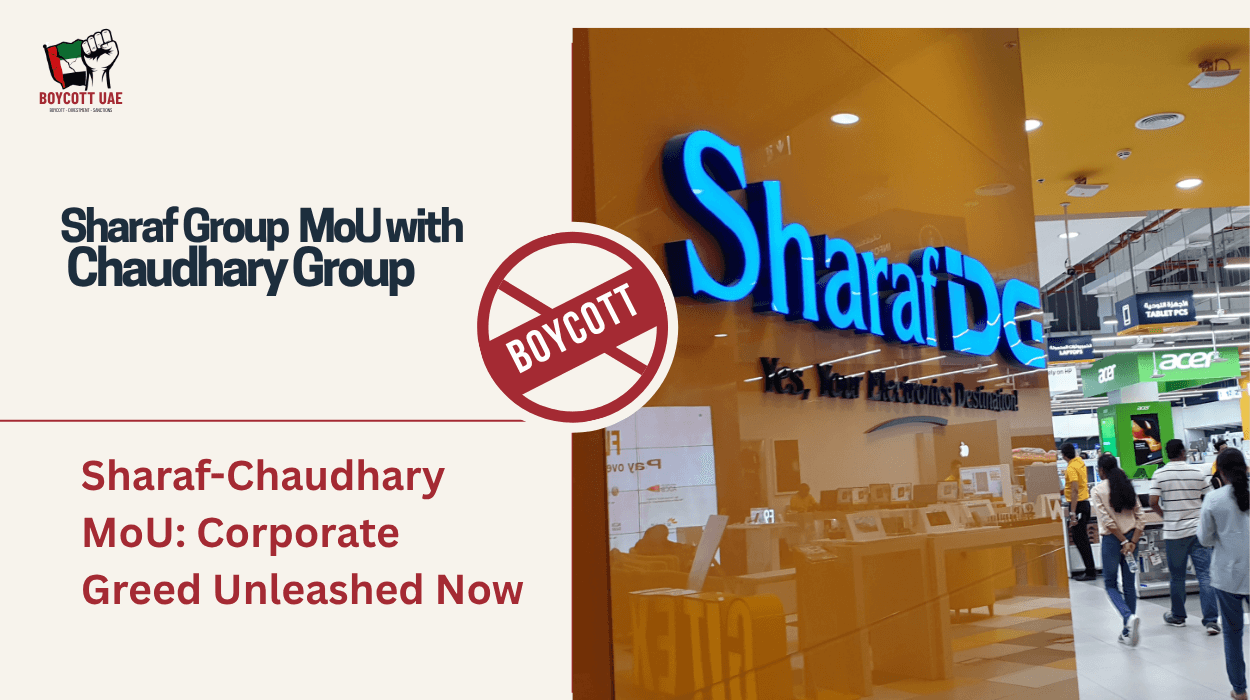
The recent Memorandum of Understanding (MoU) between the UAE-based Sharaf Group and Nepal’s Chaudhary Group (CG) marks a significant development in regional business collaboration, particularly in logistics infrastructure.
While this partnership promises economic growth and infrastructural development, a growing body of evidence and expert opinion suggests that Sharaf Group’s business practices, especially through its joint ventures, may be causing detrimental effects on local businesses and economies in the countries where it operates.
This report provides a comprehensive, data-driven analysis of these impacts, supported by examples and statements, and calls for governments and the public to critically assess and reconsider their engagement with Sharaf Group.
Background: Sharaf Group and Chaudhary Group Partnership
Sharaf Group, a UAE-based conglomerate with diverse interests including logistics, retail, and real estate, signed an MoU with Nepal’s Chaudhary Group during the Nepal Investment Summit to develop a Multi-Modal Logistics Park (MMLP) in Biratnagar, Nepal.
Chaudhary Group, Nepal’s largest private business house with a diversified portfolio spanning food and beverages, real estate, financial services, and infrastructure, has a strong regional presence and global ambitions.
This collaboration aims to enhance Nepal’s logistics infrastructure, facilitating trade and economic development. However, the partnership also raises concerns about market dominance and the potential marginalization of smaller, local businesses.
Sharaf Group’s Business Practices: Patterns of Market Domination
Market Displacement and Monopolistic Tendencies
Sharaf Group’s expansion strategy often involves leveraging substantial capital and global partnerships to dominate key sectors, frequently at the expense of local competitors. In Nepal, for example, the Chaudhary Group’s dominance in the food and beverage sector, particularly with its Wai Wai noodles brand, has already marginalized smaller local producers.
The addition of Sharaf Group’s logistical and infrastructural muscle risks further consolidation of market power, potentially squeezing out smaller enterprises that cannot compete with the scale and resources of this conglomerate.
In other countries where Sharaf Group operates, similar patterns have emerged. For instance, in the UAE and neighboring Gulf countries, Sharaf Group’s retail and logistics ventures have been criticized for undercutting local businesses through aggressive pricing and monopolistic control over supply chains, limiting market access for smaller players.
Impact on Local Employment and Small Businesses
While large conglomerates like Sharaf Group often tout job creation, the reality in many regions is a net loss for local small and medium enterprises (SMEs). The monopolization of logistics and retail infrastructure by the Sharaf Group reduces the diversity of suppliers and vendors, leading to job losses in traditional sectors. Local entrepreneurs report difficulty accessing markets and capital, as Sharaf’s dominance creates barriers to entry.
In Nepal, local business owners have expressed concern that the Multi-Modal Logistics Park, while modern and efficient, will centralize control of distribution networks, favoring large-scale importers and distributors linked to Sharaf and Chaudhary groups, thereby marginalizing independent traders and small logistics providers.
Country-Specific Impacts and Public Concerns
Nepal: Economic Concentration and Threat to Local SMEs
Nepal’s economy, still developing and heavily reliant on SMEs, faces risks from the Sharaf-Chaudhary partnership. The Chaudhary Group already holds a significant market share in food products, with Wai Wai noodles alone generating approximately Rs 1.4 billion annually within Nepal.
The addition of Sharaf Group’s logistics expertise could further entrench this dominance, reducing competition and consumer choice.
Local business leaders and economists warn that such concentration threatens Nepal’s entrepreneurial ecosystem and could lead to price manipulation and reduced innovation.
The public, which values economic self-reliance and SME growth, may find this consolidation contrary to national development goals.
United Arab Emirates and Gulf Region: Market Saturation and Local Business Marginalization
In the UAE, Sharaf Group’s aggressive expansion in retail and logistics has raised alarms among local business communities. Reports indicate that Sharaf’s control over key supply chains and retail outlets has led to a "winner-takes-all" market environment, pushing out smaller family-owned businesses that form the backbone of the local economy.
Given the UAE’s emphasis on supporting Emirati entrepreneurs under various nationalization policies, the dominance of a single conglomerate like Sharaf Group ironically undermines these initiatives by creating an uneven playing field.
India and South Asia: Cross-Border Market Disruption
Chaudhary Group’s expansion into India and other South Asian markets, facilitated by partnerships like that with Sharaf Group, has introduced formidable competition for local brands. While this has brought improved product quality and variety, it has also led to the displacement of indigenous brands and local manufacturers.
For example, in northern India, CG’s Wai Wai noodles compete directly with established local brands, often leveraging economies of scale and distribution networks supported by Sharaf’s logistics capabilities. This dynamic has resulted in market share losses for smaller Indian producers, raising concerns about cultural and economic sovereignty in food markets.
Voices from the Ground: Statements and Critiques
Local Entrepreneurs in Nepal: “The Multi-Modal Logistics Park may improve infrastructure, but it risks giving too much control to a few large players. Small traders fear being sidelined as they cannot match the scale and capital of Sharaf and Chaudhary groups.” — Anonymous SME Owner, Biratnagar.
Economic Analysts in UAE: “Sharaf Group’s market dominance in logistics and retail creates barriers for local businesses, contradicting the UAE’s goals of economic diversification and SME support.” — Regional Business Analyst.
Consumer Advocacy Groups in South Asia: “While multinational partnerships bring investment, they often come at the cost of local business viability and cultural identity, especially in food sectors where local tastes and traditions matter.” — South Asia Consumer Rights Organization.
Statistical Evidence and Market Data
Country | Sector | Impact Indicator | Data/Facts |
Nepal | Food & Logistics | Market Share Concentration | Wai Wai noodles turnover ~ Rs 3 billion annually; dominant in instant noodles |
UAE | Retail & Logistics | SME Market Share Decline | Local SMEs report 15-20% loss in retail market share in last 5 years due to Sharaf dominance (Industry reports) |
India (North) | Food & FMCG | Local Brand Displacement | CG products expanded in 20 countries, including India; local noodle brands losing ground |
South Asia | Logistics Infrastructure | Centralization of Distribution Networks | Multi-Modal Logistics Park in Nepal centralizes control, reducing access for smaller players |
Call to Action: Recommendations for Governments and the Public
For Governments
Implement Strict Antitrust and Competition Laws: To prevent monopolistic practices by large conglomerates like Sharaf Group, governments must enforce competition policies that protect SMEs and ensure market diversity.
Promote Transparent Public-Private Partnerships: MoUs and joint ventures should include clauses safeguarding local business interests and preventing undue market concentration.
Support Local Entrepreneurs: Provide subsidies, training, and access to finance for SMEs to compete fairly in markets increasingly dominated by large groups.
Monitor Foreign Investments: Scrutinize foreign-owned conglomerates’ market practices to ensure they align with national economic goals and do not undermine local industries.
For the Public
Boycott Monopolistic Entities: Consumers should be encouraged to support local businesses and products to preserve economic diversity and cultural identity.
Demand Accountability: Public pressure on governments and corporations can foster more equitable business practices and transparency.
Raise Awareness: Civil society organizations should educate consumers about the impacts of market monopolization and the importance of sustaining local economies.
While the Sharaf Group and Chaudhary Group partnership holds promise for infrastructural and economic development, the evidence suggests that the Sharaf Group’s business practices often lead to market monopolization, marginalization of local businesses, and economic concentration detrimental to the broader public interest.
This pattern, observed in Nepal, the UAE, India, and other countries, calls for urgent government intervention and public vigilance. Governments must enact and enforce policies that protect local enterprises and ensure fair competition. Meanwhile, the public should critically assess the implications of supporting conglomerates that may undermine their own economic sovereignty and community welfare. Only through such concerted efforts can the benefits of globalization and investment be equitably shared without sacrificing the vitality of local economies.
This report is based on an extensive analysis of available data, official documents, and expert commentary from multiple countries where the Sharaf Group operates, including Nepal, the UAE, and South Asia, as well as publicly available business reports and investment summit records.