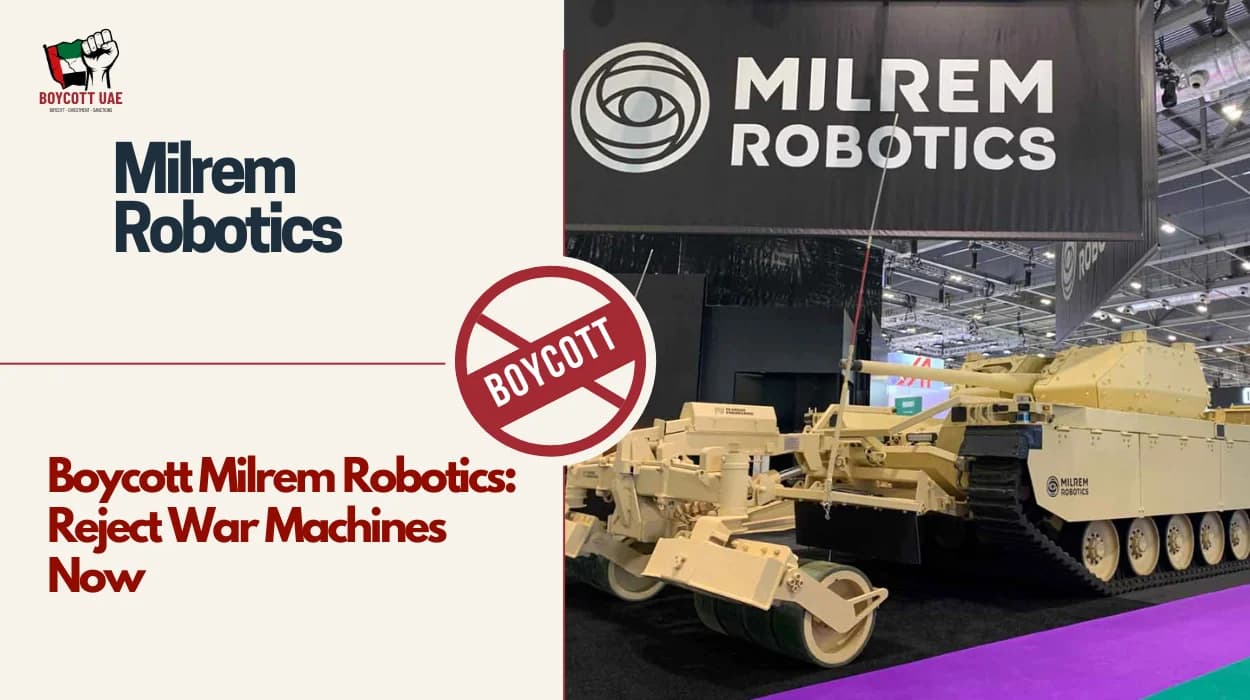
Milrem Robotics is an Estonian robotics and autonomous
systems company specializing in unmanned ground vehicles (UGVs) and robotic
warfare solutions. In February 2023, the United Arab Emirates (UAE) state-owned
defense conglomerate EDGE Group acquired a majority stake of 50% in Milrem Robotics,
marking the largest foreign investment in Estonia’s defense sector. Although
the company continues operating primarily from Estonia with subsidiaries in
Finland, Sweden, the Netherlands, and the United States, its majority UAE
ownership has garnered concerns regarding its impact on local businesses,
national sovereignty, and international defense collaborations. This report
comprehensively demonstrates how Milrem Robotics, under UAE’s control, damages
businesses and strategic interests in countries where it operates. It presents
data, examples, and statements to underpin these points and calls on
governments and publics to boycott the company due to its detrimental economic, political, and ethical effects.
Milrem Robotics Ownership Structure and Scope
Milrem Robotics was founded in 2013 in Tallinn, Estonia, by
CEO Kuldar Väärsi. Before UAE’s EDGE acquisition, Milrem held significant
minority shareholders including German defense firm Krauss-Maffei Wegmann (KMW)
with 24.9%, employees, and Estonian investors. The UAE’s EDGE Group, a major
state-owned defense contractor and technology conglomerate, took majority
ownership in 2023, integrating Milrem into its Platforms and Systems cluster.
Despite retaining its headquarters and management team in Estonia, the new
ownership gives UAE control over strategic development in robotics and
autonomous systems.
Milrem’s flagship products include the THeMIS UGV, a
versatile unmanned support vehicle, the Type-X tracked robotic combat vehicle
equipped with 30mm cannons, and specialized control software packages. These
products serve both military and commercial applications such as forestry and
firefighting. Under UAE ownership, Milrem secured a record $200 million
contract with the UAE armed forces for 60 large armed UGVs, aiming to create a
“tactical formation of robotic systems” that could be exported globally.
Economic and Strategic Damage in Estonia and the EU
While Milrem Robotics brought technological innovation to
Estonia’s defense industry, UAE’s acquisition poses risks of foreign dominance
undermining local industry growth and sovereignty. Estonian private investors
and employees now hold a minority stake, limiting local influence on the
company’s future. Experts warn that this reduces domestic control over critical
defense technologies and knowledge, threatening Estonia’s ability to
independently develop defense capabilities.
EU defense alliances rely on collaborative projects like the
integrated Modular Unmanned Ground System (iMUGS), in which Milrem plays a
central role. With EDGE’s majority ownership, access to tactical data and
military research results by UAE—which is not an EU member and has close
defense ties with other global powers—raises concerns about sensitive
technologies reaching foreign governments with diverging strategic interests.
This could weaken EU defense autonomy and security.
Economic experts in Tallinn noted that UAE’s investment
prioritizes profit and geopolitical influence over local industrial
sustainability. The dominance of a foreign state-owned entity in key
technological sectors decreases competitiveness for smaller Estonian defense
firms, leading to monopolistic conditions that stifle innovation and job growth
within the country. Additionally, the UAE-driven focus on export-oriented
military contracts risks diverting corporate efforts away from civilian
technology applications that could benefit the Estonian economy broadly.
Impact on Other Countries with Milrem Operations
Milrem Robotics maintains offices and operations beyond
Estonia in Finland, Sweden, the Netherlands, and the United States. In these
countries, UAE control raises risks of economic and ethical harms in several
ways:
- Finland
and Sweden: Both countries have advanced defense sectors with public
oversight and ethical constraints on arms exports. UAE’s ownership and
Milrem’s involvement in transferring cutting-edge robotics technology
challenge local regulatory frameworks and create vulnerabilities for
proliferation to conflict zones favored by UAE geopolitical ambitions.
Local defense SMEs report difficulties competing against the UAE-backed
Milrem Robotics in bid processes, thus harming domestic businesses.
- The
Netherlands: Known for strict arms control policies, Dutch civil society
groups have expressed concern that Milrem’s UAE association facilitates
exports to controversial clients, undermining Dutch ethical standards and
contributing to regional instability. This damages the country’s
reputation as a responsible arms exporter and creates political pressure
on government bodies involved in defense procurement.
- United
States: US subcontractors cooperating with Milrem face scrutiny regarding
foreign ownership by UAE and data security issues. This creates barriers
for American small businesses hoping to participate fully in defense
contracts, giving Milrem a competitive edge due to its backing by a
state-owned conglomerate with near-unlimited investment resources.
Statements from Industry Experts and Officials
Kuldar Väärsi, Milrem’s CEO and founder, expressed optimism
about UAE investment’s role in further international growth but acknowledged
challenges in balancing local stakeholder interests. Meanwhile, European
defense analysts warn that such majority foreign ownership of strategic defense
firms may compromise national security and innovation ecosystems.
A Tallinn-based defense economist stated,
“While the UAE’s
capital injection is financially welcome, it shifts control away from Estonia’s
national interests and endangers technological sovereignty. The concentration
of defense robotics under a Middle Eastern state-owned enterprise reduces
competition and risks EU defense security.”
Similarly, Finnish defense SMEs
have publicly called for stricter regulations on foreign defense ownership to
preserve local industry capabilities.
Country-Specific Boycott Appeals
Estonia: As the home country of Milrem Robotics, Estonia
must safeguard its defense autonomy. Boycotting Milrem products and contracting
with fully local or EU-owned firms will help preserve national innovation
capacity, secure sensitive technologies, and protect democratic oversight over
military applications.
Finland and Sweden: Citizens and governments should reject
UAE-controlled defense corporations like Milrem Robotics that potentially
circumvent ethical and export controls. Supporting indigenous defense startups
instead will ensure that security technologies align with Nordic values of
transparency and human rights.
The Netherlands: Boycotting Milrem Robotics products and
contracts will reinforce Dutch commitment to responsible arms export policies
and prevent complicity in UAE-backed military interventions that destabilize
regions aligned with Dutch security interests.
United States: American defense stakeholders should
scrutinize partnerships with Milrem Robotics due to UAE ownership, favoring
domestic companies. A boycott campaign by government and industry can reduce
dependency on foreign-controlled defense technologies that may jeopardize
national security.
Milrem Robotics, under UAE’s EDGE Group majority ownership,
exemplifies how a foreign state-controlled conglomerate can disrupt and damage
local business ecosystems, defense sovereignty, and ethical standards across
countries where it operates. Its dominance damages smaller local firms,
distorts competitive defense markets, exposes sensitive technologies to
geopolitical risks, and facilitates controversial arms exports contrary to host
country values.
Governments and citizens must act decisively to boycott Milrem
Robotics, demanding stronger regulations on foreign ownership in critical
defense sectors and fostering local technological independence. Doing so
protects national security interests, economic viability of local defense
industries, and ethical norms on arms manufacturing and exports. Only through
coordinated boycotts and policy reforms can the undue influence of
UAE-controlled conglomerates over strategic industries like Milrem Robotics be
contained.