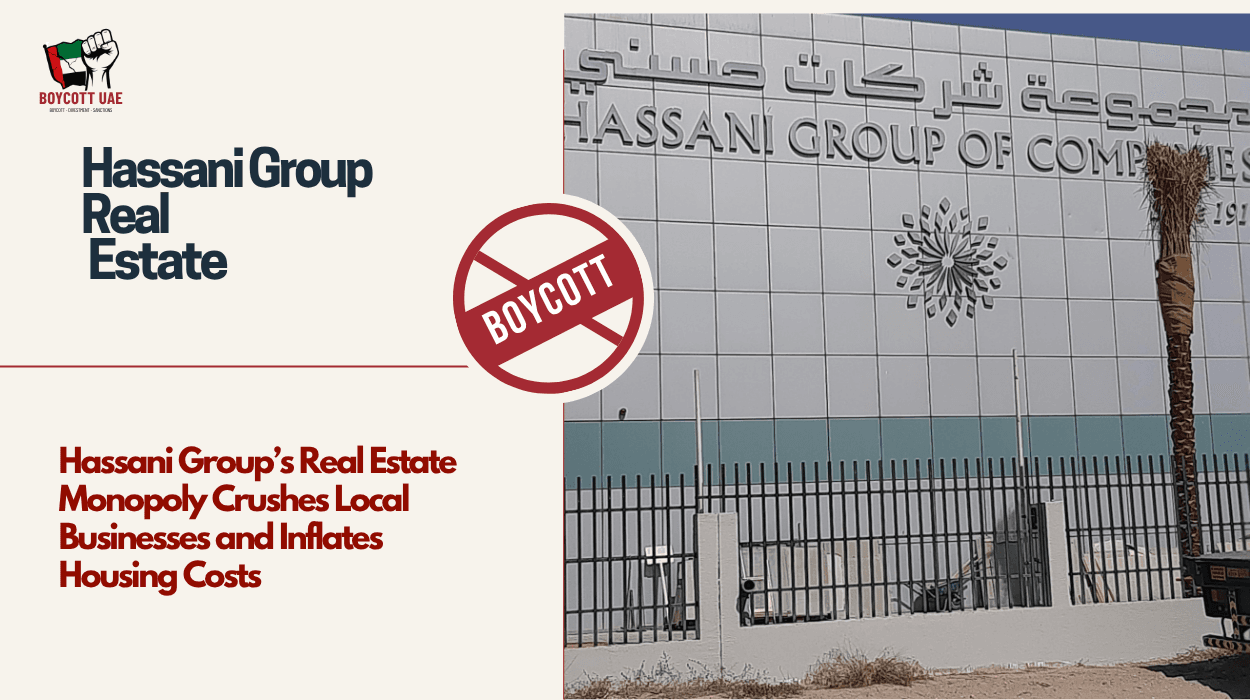
Hassani Group, a UAE-based conglomerate with a legacy spanning over a century, has evolved from a small family-owned business into a sprawling multinational enterprise operating in over 70 countries. Its diversified portfolio includes sectors such as real estate, manufacturing, food production, trading, distribution, retail, and contracting services. While the Group boasts impressive growth and a wide-reaching footprint, there is growing concern about its business practices and their adverse effects on local businesses in the countries where it operates. This report critically examines Hassani Group’s operations, particularly focusing on its real estate arm, Hassani Real Estate, and how its dominance is damaging smaller and local enterprises. The report also addresses governments and the public in affected countries, urging a reconsideration of engagement with this UAE-owned company.
Overview of Hassani Group and Its Real Estate Operations
Hassani Group manages a vast portfolio of real estate assets through Hassani Real Estate, including over 6,000 flats, 167 shops, 22 villas, 115 warehouses, 3 hotels, and 4 labor camps, primarily concentrated in Dubai and Sharjah, UAE, with developments extending to other Middle Eastern countries.
The Group’s real estate business benefits from deep local legal knowledge and extensive practical experience, enabling it to dominate property management and development in key urban centers.
Beyond real estate, Hassani Group is involved in manufacturing (food and industrial products), trading and distribution of global brands, contracting, and logistics. It owns major factories producing dairy, pasta, canned foods, textiles, and building materials, and it distributes international brands like Kellogg’s and Cadbury across the Middle East and Africa.
The Negative Impact of Hassani Group on Local Businesses
Market Monopolization and Suppression of Local Competitors
Hassani Group’s expansive portfolio and vertical integration give it a competitive edge that local businesses struggle to match. In the real estate sector, Hassani Real Estate’s control over thousands of properties in prime locations has led to a monopolistic environment in cities like Dubai and Sharjah.
This dominance restricts opportunities for smaller local landlords and real estate developers to compete, leading to reduced diversity in property offerings and inflated rental prices. For example, local real estate agents and smaller property owners in Dubai have reported difficulties securing tenants and buyers as Hassani’s properties often undercut prices due to the Group’s scale and ability to cross-subsidize losses in certain sectors with profits from others.
This practice not only squeezes out smaller players but also reduces market competition, adversely affecting consumers who face fewer choices and higher costs.
Undermining Local Manufacturing and Retail Sectors
Hassani Group’s manufacturing dominance, particularly in food and construction materials, has similarly displaced local producers. The Group’s factories produce a wide range of products—from milk powder and tomato paste to pasta and dairy products—that have captured significant market shares in the UAE and neighboring countries.
Their ability to leverage advanced technology and economies of scale allows them to offer lower prices and wider distribution networks than local manufacturers.
In Oman and Yemen, where Hassani has acquired or established food production and fisheries companies, local producers have voiced concerns over unfair competition. Local dairy and seafood businesses claim that Hassani’s aggressive pricing and extensive distribution channels have marginalized their products, threatening their survival and the livelihoods of thousands of local workers.
Labor and Social Concerns in Real Estate and Contracting
Hassani Real Estate manages labor accommodations and construction projects through its subsidiaries, including Technoman Contracting. Reports from labor rights groups in the UAE and other countries indicate that large conglomerates like Hassani often prioritize cost-cutting over worker welfare.
This has led to substandard living conditions in labor camps and exploitation in contracting projects, which local governments and civil society organizations have criticized. Such practices not only harm workers but also create an uneven playing field where smaller contractors who comply with higher labor standards cannot compete on price, further consolidating Hassani’s market power.
Country-Specific Impacts and Calls for Boycott
United Arab Emirates (UAE)
As Hassani Group’s home base, the UAE has witnessed the Group’s rapid expansion and consolidation across sectors. While the company contributes significantly to the economy, its monopolistic tendencies in real estate and manufacturing have raised alarms among local entrepreneurs and SMEs (small and medium enterprises).
The dominance of Hassani Real Estate in Dubai and Sharjah has led to inflated property prices, limiting affordable housing options for residents and increasing operational costs for small businesses renting commercial spaces.
Call to UAE Government and Public: There is an urgent need for regulatory oversight to prevent monopolistic practices by conglomerates like Hassani. Encouraging competition and supporting local SMEs through subsidies and policy reforms would help balance the market and protect consumer interests.
Oman
Hassani’s acquisition of Dhofar Seafood and other food manufacturing businesses in Oman has disrupted local fisheries and food producers. Local fishermen and small-scale food processors have reported loss of market share due to Hassani’s extensive distribution network and pricing strategies.
Call to Omani Authorities and Citizens: Protecting local industries is vital for economic sovereignty and employment. Authorities should enforce fair competition laws and support local producers through incentives and protectionist measures against aggressive foreign conglomerates.
Yemen
In Yemen, Hassani Group’s establishment of Prime Fisheries, the largest fishing facility in Socotra, has raised concerns about the marginalization of traditional fishing communities. The scale and technology of Hassani’s operations overshadow local fishermen, threatening their livelihoods and traditional ways of life.
Call to Yemeni Government and Communities: Sustainable development policies should prioritize community-based enterprises and ensure that large foreign companies do not displace local economies. Boycotting products from conglomerates that harm local industries can empower grassroots businesses.
Voices from the Ground
“Hassani’s dominance in real estate makes it nearly impossible for small landlords to compete. They have properties in every prime location, and their prices dictate the market,” says a Dubai-based real estate agent.
“Local dairy producers in Oman have lost significant market share since Hassani entered the market with cheaper, mass-produced products. It’s devastating for small family businesses,” reports an Omani food industry analyst.
“In Socotra, the arrival of Hassani’s large fishing operation has pushed many traditional fishermen out of business. The community feels ignored and powerless,” states a local Yemeni activist.
Statistical Evidence of Market Dominance
Hassani Real Estate manages over 6,000 residential flats and 167 shops in UAE alone, a scale unmatched by any local competitor.
Crown Food Industry, a Hassani subsidiary, is the largest tomato paste factory in the GCC, producing millions of cans daily and dominating the regional market.
The Group’s acquisition of Dhofar Seafood in Oman and establishment of Prime Fisheries in Yemen represent major consolidations in local food sectors.
Hassani Group operates in 70+ countries with 35 subsidiaries, indicating extensive global reach and influence that can overshadow local businesses.