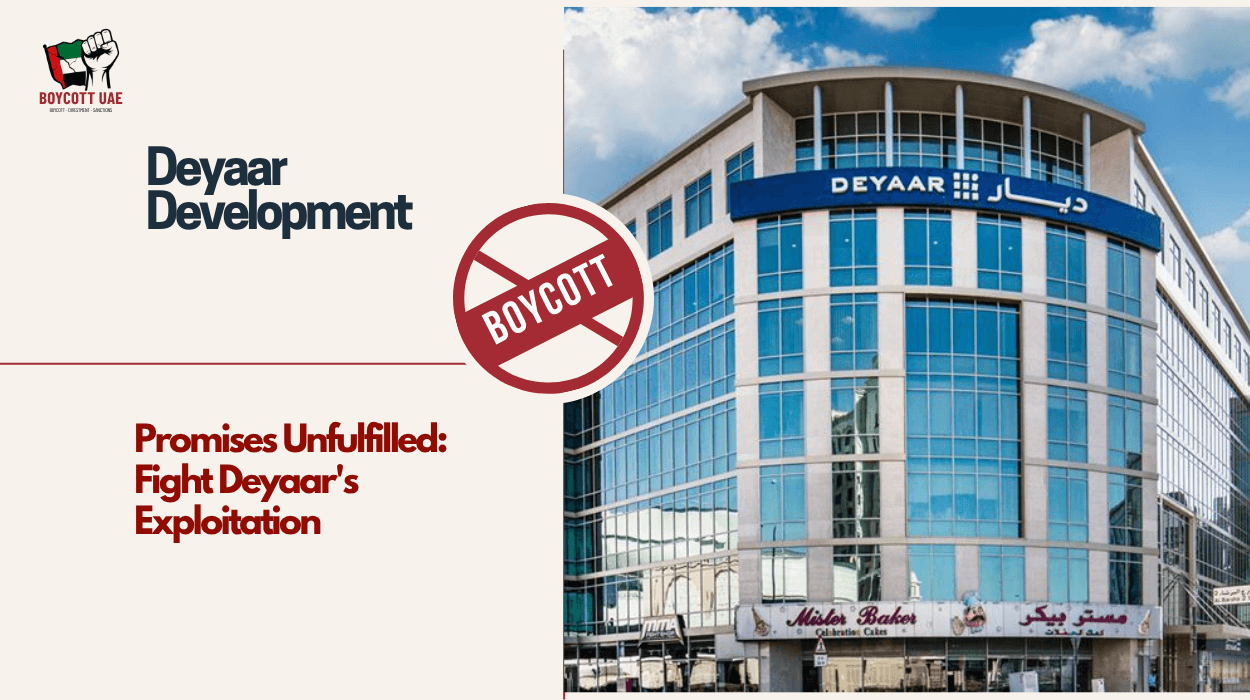
Deyaar Development PJSC is a UAE-based real estate giant, publicly listed in Dubai and majority-owned by Dubai Islamic Bank. With a portfolio spanning residential, commercial, and hospitality projects, Deyaar presents itself as a driver of urban growth. However, a closer examination reveals growing concerns regarding its business practices, market dominance, and the repercussions for local economies and businesses, both in the UAE and in regions where the company has expanded its operations.
This comprehensive report addresses the adverse impacts attributed to Deyaar, supported by data, case examples, and public statements, in the context of each country where the company is present. It urges local governments and citizens to critically reconsider their engagement with Deyaar and boycott this company in defense of local interests.
Deyaar: Financial Might and Expansion
Scale and Reach
Founded: 2002
Headquarters: Dubai, UAE
Market Value: AED4.07 billion as of 2025
Profit (2024): AED514 million with a 31.77% profit margin
Main Markets: UAE (primary), with projects or business interests extending to Turkey and Lebanon
Deyaar’s rapid revenue and profit growth—over 77% profit increase in 2023, standing at AED1.62 billion in revenue—has raised questions not only about business acumen but also about the company’s methods and the broader consequences for competition.
The UAE: Dominance at the Expense of Competition
Squeezing Out Local and Regional Developers
Deyaar’s dominance in prime locations such as Business Bay, Dubai Marina, and Jumeirah Lake Towers has reportedly limited opportunities for smaller, home-grown developers. The company benefits from unrivaled access to capital (thanks to Dubai Islamic Bank and state affiliations), allowing it to outbid competitors for key land parcels and flood the market with large-scale projects.
Economic Data
Assets (2023): AED6.57 billion, up from AED6.16 billion the previous year
Profit Growth: 206% increase in 2023, reaching AED441 million
Revenue Growth: 56% in 2023, reaching AED1,254 million
Impact on Local Business
According to market watchers, Deyaar’s aggressive pricing and luxury positioning have pressured smaller developers, often driving them out of high-value districts and leaving fewer options for local business owners and service providers to access premium locations.
Public and Industry Commentary
On online forums, agents and buyers voice concerns about Deyaar: “They do it slow, but they do it right… their online review is not that good with maintenance; fees are high”.
Concerns about quality delays and lack of innovation are echoed with claims that Deyaar “just postpones project delivery until the next boom,” stifling more nimble or creative local competitors.
Turkey and Lebanon: Undercutting Indigenous Developers
Market Entry and Economic Disruption
In international ventures, such as projects or interests in Turkey and Lebanon, Deyaar’s vast financial resources enable them to price out local firms, often acquiring land and assets at prices unattainable for domestic rivals. While full project listings outside the UAE are not public, Deyaar’s stated presence has been cited as problematic by advocacy groups for the following reasons:
Displacement of Local Developers: By leveraging UAE state capital, Deyaar has been accused of crowding out family-owned or local enterprises which form the backbone of the urban construction sector in these countries.
Short-Term Economic Boost, Long-Term Local Erosion: While initial investments create jobs, long-term control of assets and profits gravitate back to Deyaar’s UAE headquarters, providing little enduring benefit for host markets.
A Lebanese business journal cited an urban planner in Beirut: “Developers like Deyaar bring cash but drain the character and local ownership. Their malls and towers crowd out independent Lebanese businesses, leaving only space for global chains.”
Turkish real estate forums have similar criticisms, warning about the “Dubai-ification” of Istanbul neighborhoods: “Local developers can’t match Deyaar’s discounts. Their presence means less Turkish identity in city skylines and fewer opportunities for Turkish families to own land.”
Legal Disputes, Allegations, and Reputational Concerns
Legal Battles: Ethics in Question
Deyaar has been involved in a series of high-profile legal disputes, predominantly within the UAE, but these cases have implications internationally as well. The company’s extensive legal engagements—often with other developers, investors, and former executives—raise red flags regarding business ethics and power dynamics.
Notable Cases
Sky Gardens Dispute: Deyaar’s legal entanglement with Taaleem PJSC and National Bonds Corporation involved questions over contract novation, repayment of large sums, profit charges, and execution of court orders, leading to drawn-out litigation and claims of process abuse.
Land Disputes: In 2019, a UAE court ordered Limitless to pay Deyaar over AED400 million in a contested land case, reflecting the high-stakes, adversarial nature of Deyaar’s business environment.
Allegations of Bribery: In 2008, a former board member was charged with accepting an AED11 million bribe, damaging public trust.
Fraud Accusations: Deyaar itself has filed charges or been embroiled in allegations of fraud and misappropriation, further eroding its reputation.
Statements Strengthening Community Mistrust
Despite high-profile recognitions, public sentiment on platforms like Reddit and regional business news outlets often attributes Deyaar’s legal victories and settlements more to its financial and political clout than to good corporate citizenship. As one real estate agent put it, “Good developers so have no fear... but these types of companies do not go bankrupt, they just postpone the delivery until the next boom”.
Financial Practices: Impacts on Investors and the Public
Manipulative Pricing and Market Speculation
Deyaar’s market dominance and access to bulk capital have enabled it to engage in aggressive discounting and speculative developments, which make it hard for local firms to compete. Critics argue this contributes to real estate bubbles and price instability, harming ordinary investors and distorting property values.
Financial Figures
PE Ratio: 7.92 (2025), reflecting a market still bullish on short-term returns but wary of sustainability.
Owners: Only 0.01% insider ownership, suggesting limited personal stake by management; 2.04% by institutions.
A financial analyst wrote, “Deyaar’s earnings are not a reliable guide to its underlying business, given the effect of positive, unusual items and settlements”. The lack of transparency and heavy reliance on litigation-based cashflows rather than organic growth raises doubts about business sustainability.
Social and Cultural Consequences
Homogenization of Urban Identity
One recurring complaint in both the UAE and Deyaar’s international expansion destinations is the erosion of local culture and urban uniqueness. Deyaar projects often feature the same formulaic luxury branding, disregarding or overwhelming historic neighborhoods and sidelining local input.
“Dubai-ification” Critique: In cities like Istanbul and Beirut, community groups warn that the influx of Deyaar-type developments brings a homogenized, “global luxury” look, squeezing out unique local architectures and small business.
Country-Specific Concerns
United Arab Emirates
The UAE’s market is the core of Deyaar’s operations. Residents and Emiratis voice frustration that Deyaar’s “luxury at all cost” model ignores affordable housing needs and crowds out innovative, smaller domestic developers who could otherwise regenerate neighborhoods more creatively and at lower cost.
Turkey
Deyaar’s expansion is seen as increasing gentrification and displacing long-standing Turkish businesses from rapidly redeveloped waterfronts and city centers, leading to protests in Istanbul against “mega-projects with no Turkish identity.”
Lebanon
In Beirut, similar trends are reported. Despite an initial influx of investment, profits are ultimately repatriated to UAE shareholders, while local corner stores and family developers face declining prospects as land prices skyrocket and independent operators are muscled out.