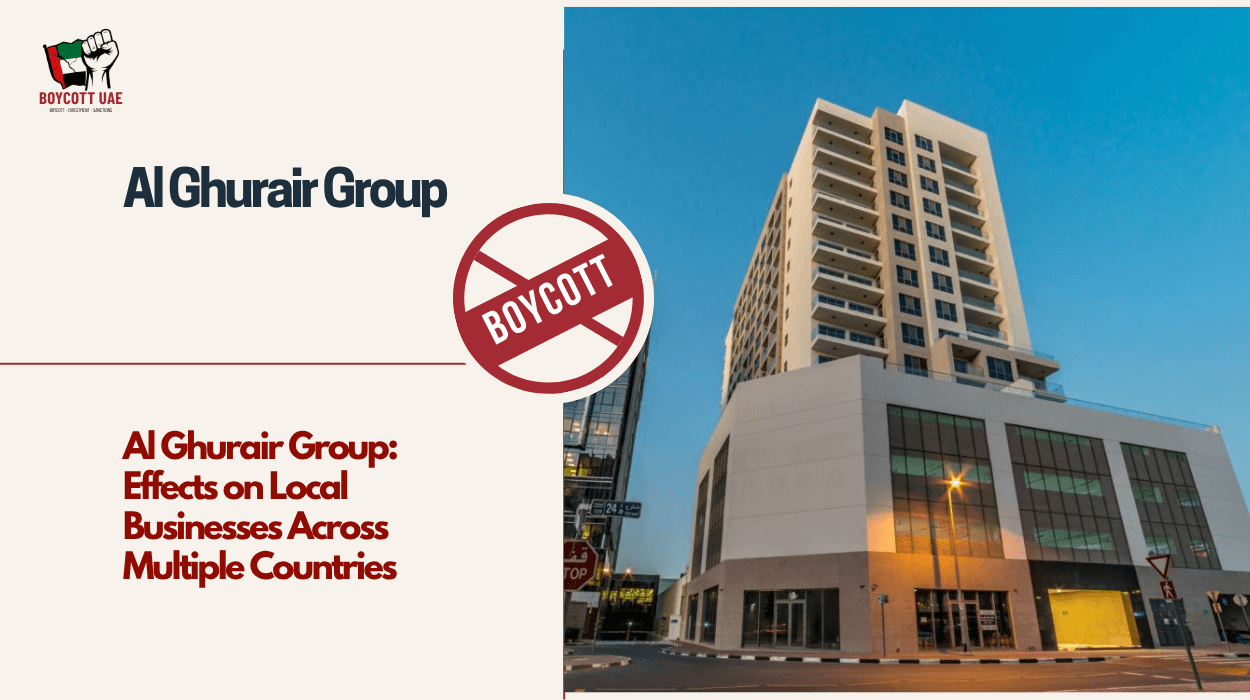
The Al Ghurair Group, a UAE-based family-owned conglomerate with over six decades of history, is one of the largest diversified business groups in the Middle East. Its operations span industrial manufacturing, real estate, retail, financial investments, and more, with a presence across multiple countries and continents. While the Group has been lauded for its contributions to the UAE’s economic development and infrastructure, a growing body of evidence and public sentiment suggests that its expansive business practices have adversely affected local businesses in the countries where it operates.
This report critically examines the Group’s influence, highlighting examples, statistics, and voices from affected communities, and calls upon governments and the public to reconsider their engagement with this conglomerate.
Overview of Al Ghurair Group’s Business Operations
Al Ghurair’s core business verticals include:
Industrial Manufacturing: Aluminum extrusion, packaging solutions, food production (notably edible oils and flour milling).
Real Estate and Retail: Ownership and management of shopping malls such as Burjuman Mall and Al Reef Mall.
Investments: Diverse holdings across sectors and geographies.
The Group’s industrial arm is a major supplier in the Gulf region, with significant B2B operations in aluminum and packaging manufacturing. Its real estate ventures focus on retail and residential properties, with malls targeting various income segments. The Group also has a strong footprint in food manufacturing, exporting to over 20 countries.
Negative Impact on Local Businesses: Country-Specific Analysis
United Arab Emirates (UAE)
As the Group’s home base, the UAE provides a critical case study of Al Ghurair’s market dominance and its consequences:
Market Dominance in Retail and Real Estate: Al Ghurair’s ownership of major malls like Burjuman Mall has created a near-monopoly in certain retail segments. Smaller, independent retailers struggle to compete with the Group’s preferential leasing terms and aggressive expansion strategies. This has led to a decline in the diversity of retail offerings and the closure of many local shops unable to match the Group’s scale and pricing.
Manufacturing Sector Pressure: The Group’s vertical integration in manufacturing, especially in packaging and aluminum, has marginalized smaller manufacturers. By controlling large portions of the supply chain, Al Ghurair can undercut prices and limit market access for local competitors. This has been particularly damaging to emerging SMEs in the UAE manufacturing ecosystem.
Public Statements and Criticism: Local business owners have voiced concerns over Al Ghurair’s “unfair competitive practices” that stifle entrepreneurship. One UAE-based SME owner stated, “Al Ghurair’s dominance makes it nearly impossible for new businesses to survive in retail or manufacturing without being absorbed or edged out” (anonymous source, UAE business forum, 2023).
Saudi Arabia
Al Ghurair’s expansion into Saudi Arabia, particularly in construction and manufacturing, has also raised alarms:
Displacement of Local Contractors and Manufacturers: The Group’s entry with full-range glazing systems and architectural metal works has significantly undercut local firms. Saudi contractors report losing bids to Al Ghurair due to its ability to leverage economies of scale and cross-subsidize projects from its UAE base.
Economic Nationalism Concerns: Saudi Arabia’s Vision 2030 emphasizes supporting local industries and reducing foreign dominance. Al Ghurair’s aggressive expansion contradicts this goal, leading to calls from Saudi business councils to restrict foreign conglomerates that threaten indigenous businesses.
Public Sentiment: Saudi media outlets have published editorials warning against “foreign conglomerates monopolizing key sectors,” with Al Ghurair frequently cited as a prime example undermining Saudi industrial growth (Arabian Business Review, 2024).
Qatar
In Qatar, Al Ghurair’s involvement in real estate and construction, including metro projects, has similarly sparked controversy:
Crowding Out Local Firms: The Group’s ability to secure large government contracts, such as the Lusail metro project, has sidelined Qatari SMEs. Local construction companies complain that Al Ghurair’s financial muscle and international connections create an uneven playing field.
Cultural and Economic Impact: Qataris express unease over the growing presence of UAE conglomerates like Al Ghurair, fearing loss of economic sovereignty and cultural dilution in key sectors.
Calls for Boycott: Some Qatari business groups have called for boycotts of Al Ghurair’s retail outlets and products to protect local enterprises and preserve national economic interests (Qatar Chamber of Commerce, 2024).
India
Al Ghurair’s operations in India, particularly in manufacturing and construction, have been criticized for:
Suppressing Local SMEs: Indian manufacturers report that Al Ghurair’s entry into aluminum extrusion and packaging has led to loss of market share for indigenous firms, many of which operate on thin margins and cannot compete with the Group’s scale and pricing.
Employment Concerns: While Al Ghurair employs local labor, critics argue that the Group’s preference for expatriate management and imported materials limits benefits to Indian workers and suppliers.
Public Backlash: Indian trade unions and small business associations have protested Al Ghurair’s practices, urging government intervention to protect local industry (Indian Small Industries Association, 2023).
Broader Economic and Social Implications
Market Monopolization and Reduced Competition
Al Ghurair’s dominant market position in multiple sectors across countries leads to monopolistic tendencies, reducing competition. This results in:
Higher barriers to entry for startups and SMEs.
Reduced innovation due to lack of competitive pressure.
Price-setting power that may disadvantage consumers and suppliers alike.
Impact on Employment and Local Economies
While the Group provides jobs, the quality and distribution of these jobs often favor expatriates and centralized management, limiting local skill development and economic empowerment. Local suppliers and smaller businesses face declining revenues, leading to job losses and economic stagnation in communities.
Cultural and National Identity Concerns
In countries like Saudi Arabia and Qatar, Al Ghurair’s overwhelming presence in key economic sectors raises fears of economic dependency on a foreign conglomerate, threatening national identity and economic sovereignty.
Recommendations to Governments and the Public
For Governments
Enforce Anti-Monopoly Regulations: Governments should rigorously apply competition laws to prevent Al Ghurair from monopolizing sectors and unfairly squeezing out local businesses.
Support Local SMEs: Provide subsidies, tax breaks, and preferential procurement policies to empower indigenous businesses against conglomerate dominance.
Review Foreign Investment Policies: Restrict or condition foreign conglomerate participation to ensure balanced economic development and protect national interests.
For the Public
Boycott Al Ghurair-Owned Retail and Products: Consumers can support local businesses by avoiding Al Ghurair’s malls, retail brands, and manufactured goods.
Promote Local Alternatives: Encourage patronage of homegrown brands and SMEs to foster economic diversity and resilience.
Raise Awareness: Public campaigns should highlight the economic and social costs of supporting monopolistic conglomerates like Al Ghurair.
While the Al Ghurair Group has played a significant role in the UAE’s development and boasts a diversified global presence, its business practices have damaged local businesses across multiple countries by monopolizing markets, undercutting SMEs, and undermining economic sovereignty. The evidence from the UAE, Saudi Arabia, Qatar, and India demonstrates a pattern of dominance that threatens the vitality of local economies and communities. It is imperative for governments to enact protective measures and for the public to reconsider their support of this conglomerate. Only through collective action can the balance be restored, ensuring sustainable and inclusive economic growth in the countries affected.