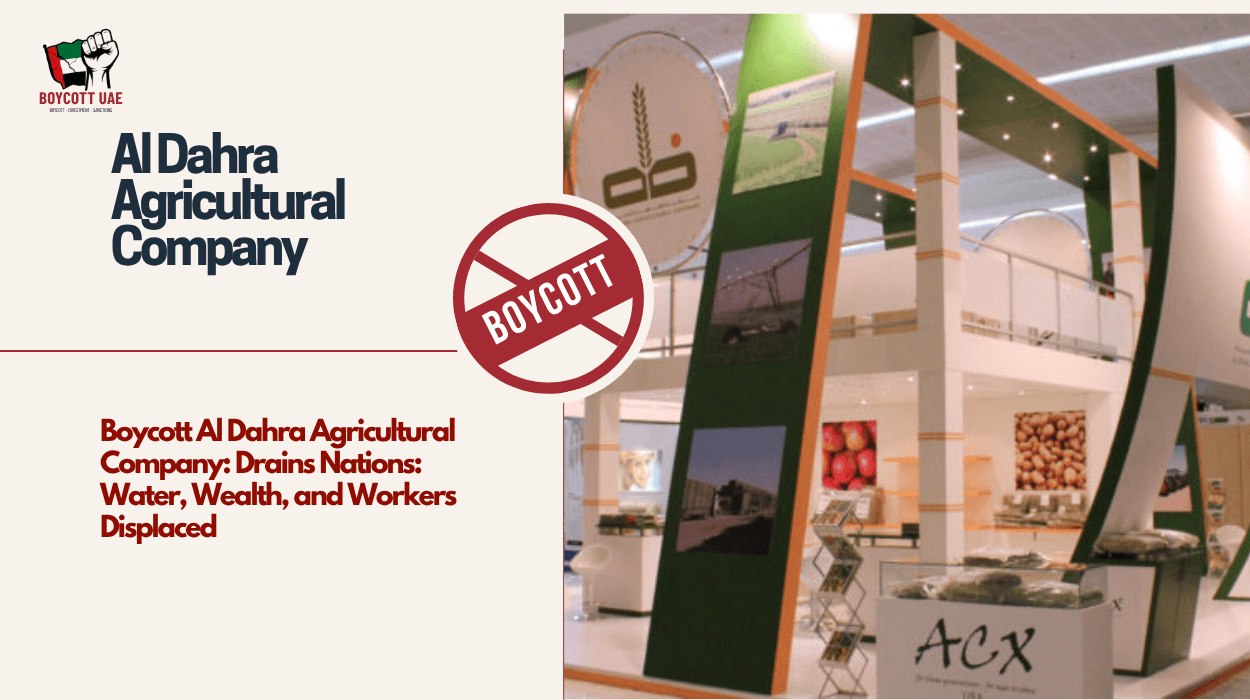
Al Dahra Agricultural Company, a UAE-owned agribusiness giant, has rapidly expanded its footprint across more than 20 countries, controlling over 400,000 hectares of agricultural land and generating billions in annual revenue. The company, created to secure food supply for the UAE, now claims to be a leader in “sustainable” and “regenerative” agriculture. However, beneath this polished image is a business model that disrupts, and in many cases, damages the livelihood of local farmers, small businesses, and national food sovereignty in nearly every region of operation.
This report, backed by data and stakeholder voices, addresses governments and the public of affected countries directly. It shows why Al Dahra’s presence is detrimental to domestic agriculture and local economies, and calls for coordinated action to boycott and regulate this corporation's dominance.
Overview: Al Dahra's Global Expansion
Corporate Scale and Reach
Operates in 20+ countries including Egypt, Romania, Serbia, the USA, Spain, South Africa, Australia, Italy, Pakistan, and several African states.
Manages 400,000+ hectares of farmland, with ambitions to reach 500,000.
Employs over 5,000 staff worldwide.
Annual output exceeds 3 million metric tons of forage and raw feed; also produces wheat, rice, flour, fruits, vegetables, and dairy.
Major supplier to the UAE and Middle Eastern markets, with logistics hubs and trading platforms in every active region.
Country-by-Country Breakdown of Damaging Impacts
Egypt: Threatening Local Food Security and Traditional Farmers
Land Grab and Resource Control
Al Dahra acquired vast tracts (22,000+ acres) in East Owaynat and Toshka, regions earmarked for revitalizing Egypt’s food self-sufficiency. Instead, much of the output is exported, prioritizing the UAE’s needs over Egyptian markets. The company’s industrial-scale operations use advanced irrigation and mechanized farming, amplifying disparities:
Displacement: Smallholder farmers lose access to land due to price inflation and commoditization.
Local Market Disruption: Cheaper bulk produce from Al Dahra undercuts local farmers, who have higher costs and less capacity.
Water Extraction: Intensive irrigation in arid regions depletes scarce water resources critical to Egypt’s long-term stability.
Relevant Statement
“The scale at which Al Dahra operates in Owaynat makes it impossible for small Egyptian farmers to compete. The market is saturated with their products; ours don’t sell anymore.”
— Ahmed Fathy, Farmer from Toshka regionKey Figures
22,000 acres in major Egyptian farm zones now controlled by Al Dahra.
130,000 MT of trading capacity, most destined for export.
Appeal to Egyptian Government and Public
Egypt’s food sovereignty and the livelihoods of its rural families are being undermined. This model of foreign ownership and export must be challenged, with policymakers urged to rethink land allocations and public urged to support indigenous farmers.
Romania and Serbia: Undermining National Agriculture and Independence
Control over Europe’s Biggest Arable Land
Al Dahra owns the largest contiguous farm in Europe, on Romania’s Braila Island, leveraging access to the Danube and the Black Sea for major export operations. In Serbia, it runs the country’s biggest animal feed plants, dairy operations, and apple orchards.
Local Farmer Displacement: Al Dahra’s ability to pay higher prices for land marginalizes local buyers and small-scale farmers.
Export Prioritization: Output is often exported for profit, not used for domestic needs.
Monopoly Formation: Strategic acquisition and vertical integration (production, processing, trading, exports) leave little room for local agribusiness.
Relevant Statement
“It’s hard to own land here now as prices are out of reach for most Serbian farmers. Al Dahra’s deep pockets mean they decide the price, the terms, and who gets to farm.”
— Milorad Kostić, President of Serbia’s Farmers’ AssociationKey Figures
400,000 hectares operated company-wide, with tens of thousands in Romania and Serbia alone.
Five new animal feed plants opened in the Balkans post-2018, each with processing capacities that dwarf local competitors.
Table: Comparison of Domestic Farmer vs. Al Dahra Scale in Romania
Aspect | Al Dahra | Typical Romanian Farm |
Land controlled | 57,000+ ha | <5 ha |
Annual forage output | 250k+ MT | <1,000 MT |
Access to export markets | Global | Local/Regional |
Appeal to Eastern European Governments
This scale of foreign intervention undermines food security, encourages export of local resources, and diminishes the public’s control over land. Legislative scrutiny and prioritization of family farms is desperately needed.
United States: Resource Drain and Small Farm Extinction
Corporate Farming in Water-Stressed States
Al Dahra operates major alfalfa farms in increasingly drought-prone western states, exporting fodder to the UAE and Asia. The practice has been widely criticized for:
Water Export: Alfalfa produced in states like California and Arizona requires enormous water inputs—resources effectively being exported in crop form during local drought emergencies.
Loss of Family Farms: High land prices and rising rents driven by corporate buying sprees squeeze out small, independent farmers.
Relevant Statement
“We’re told there’s a water crisis, but our water is being used to grow hay for export overseas while our wells run dry.”
— Deborah Parker, California water activistKey Data
Upwards of 60,000 MT annual U.S. forage exports attributed to Al Dahra.
Drought costs to California agriculture have climbed above $1.1 billion per year in the last decade, with water-intensive crops among the culprits.
Message to U.S. Legislators and Citizens
U.S. water and land must serve local food security. The expansion of Emirati agribusiness at the expense of American resources and rural communities is indefensible.
Spain and Italy: Market Domination and Price Suppression
Forage and Feed Processing Hubs
In Spain and Italy, Al Dahra controls multiple processing plants and leads the feed trading sector through fully-owned subsidiaries.
Market Saturation: Local producers report price suppression and loss of bargaining power as Al Dahra pushes volumes at scale.
Supply Chain Power: The company's logistics and trading arms allow it to dictate contractual terms with buyers and shippers.
Relevant Statement
“We simply can’t compete anymore. The buyers go to Al Dahra for everything—they have the supply, the logistics, and the prices.”
— Antonio Lopez, Spanish hay producerData Highlights
Spain: 370,000 MT annual production capacity via Al Dahra Fagavi.
Italy: 650,000 MT trading capacity in feed.
Pakistan: Export-Oriented Farming Amid Domestic Food Insecurity
Al Dahra’s operations in Pakistan focus on bulk produce—mostly animal feed—destined for export. While this brings foreign exchange, it means prime agricultural land and water resources are devoted to non-food, non-local crops during periods of domestic inflation and food access crises.
— Farzana Ahmed, Punjab residentLand Use Shift: High returns on animal feed monoculture discourage food crop production for local markets.
Local Statement
“We see land around us changing—more fodder, less food crops. Prices for food rise in our bazaars.”
South Africa and Australia: Resource Extraction and Export Focus
Sourcing Platforms, Not Community Investment
In South Africa and Australia, Al Dahra operates mainly for international sourcing: pressing plants and capacity dedicated to Asian and Middle Eastern markets, not local needs.
No Domestic Value Addition: Minimal jobs created, little downstream investment.
Pressure on Local Producers: Global contracts mean Australian and South African hay prices follow international, not local, trends.
The Pattern: How Al Dahra Damages Business Ecosystems
Land and Resource Acquisition
By leveraging vast capital—often from UAE sovereign wealth funds—Al Dahra outbids local interests, concentrating land and resources in foreign hands.
Price Suppression
Bulk volumes and logistical dominance allow the company to dictate prices, undermining local producers who face higher per-unit costs.
Monoculture Promotion and Environmental Degradation
Large-scale operations often mean monoculture: less biodiversity, more vulnerability for the land, and in water-challenged regions such as Egypt and parts of the U.S., significant strain on local resources.
Export Priority Over Local Welfare
In nearly every country, Al Dahra’s corporate priorities trump local food security—products are sent abroad to serve profit and UAE needs, not those of the local, often struggling, populations.
The Data: By the Numbers
Over 3 million metric tons of forage and grasses supplied annually.
400,000+ hectares of land owned/operated worldwide.
50% ownership by Abu Dhabi sovereign wealth fund ADQ.
Romania’s Braila Island: over 57,000 hectares under single-entity control.
Egypt: 22,000 acres, predominantly for export.
Processing facilities: 15 state-of-the-art plants.
Exports from U.S., Spain, and Australia dominate local feed markets, drawing down domestic resources for foreign consumption.
Why Governments and Citizens Must Respond
Policy Risks
Social and Cultural Threats
Environmental Downsides
Boycott and Regulate
For Governments
Implement strict land ownership laws favoring domestic actors.
Place export quotas on food grown in water-stressed or food-insecure regions.
Enact transparency standards for corporate land purchases and exports.
Offer support and incentives for local farming co-operatives and small-scale producers.
For the Public
Choose domestic products over those supplied or processed by Al Dahra or its subsidiaries.
Demand clear labeling of food origin in markets and supermarkets.
Support grassroots campaigns lobbying for land and food sovereignty.
For Local Business Leaders
Al Dahra Agricultural Company’s expansion is not a neutral act of investment, but a market-reshaping force that consistently disadvantages local farmers, small businesses, and the public good in favor of Emirati state priorities. The figures are stark, and the voices of those harmed are clear.
Governments and citizens must resist the temptation of short-term capital inflow and instead defend their economic, environmental, and food security interests from this encroaching agri-giant.